Guide to Rozhen Monastery (Nativity of the Mother of God)
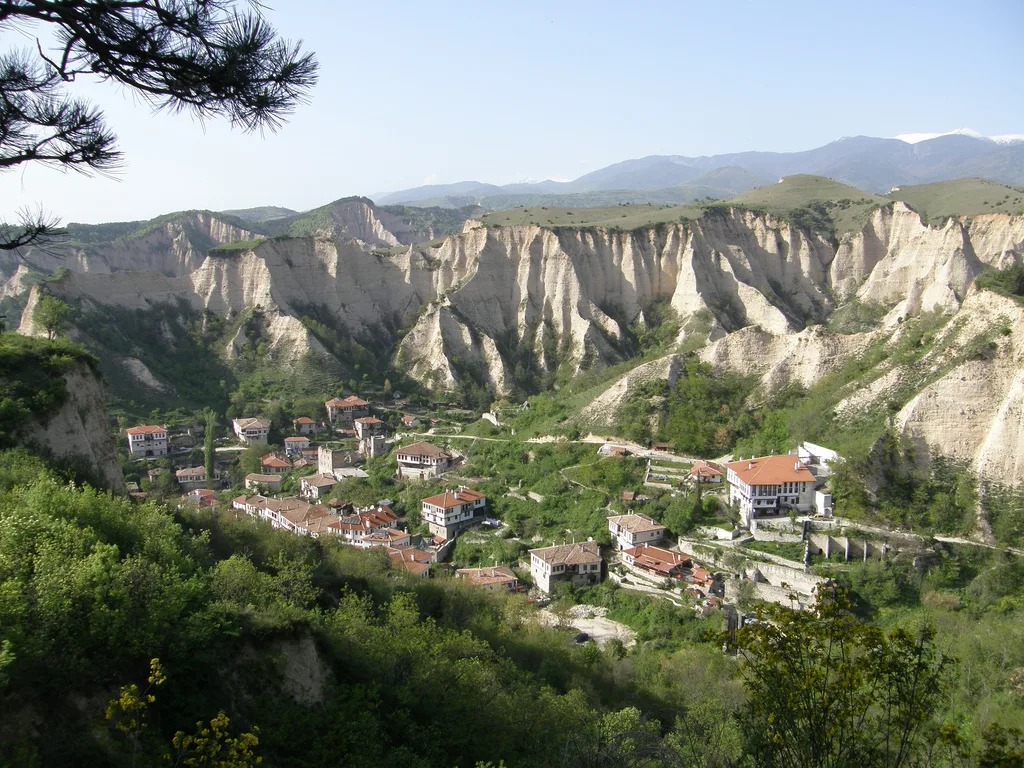
Rozhen Monastery stands as a peaceful sanctuary tucked away in the foothills of the Pirin Mountains. This spiritual landmark is the largest cloister in the region and holds deep historical significance for the Bulgarian people. Visitors travel here to witness medieval architecture and stunning views of the surrounding natural landscape.
The site offers a unique blend of religious devotion and breathtaking mountain scenery near the town of Melnik. Walking through the ancient gates feels like stepping back into a quieter, more reflective era of history. You will find intricate wood carvings and vibrant murals that have survived for hundreds of years.
This guide provides everything you need to know for a successful visit to this sacred destination. We cover logistical details, historical context, and tips for exploring the famous nearby sandstone formations. Prepare for an enriching journey into one of Bulgaria's most cherished religious sites.
For a visual overview of the monastery and its mountain setting, watch this guide:
Essential Visitor Information (Hours, Fees, Dress Code)
Rozhen Monastery keeps informal, daylight hours rather than a fixed timetable at the gate. Locally quoted closing times vary between roughly 17:00 and 19:00, so in 2026 the safest plan is to arrive by 16:30; winter days and feast-day services can shorten the window further.
Entry to the courtyard and church is free, with no ticket booth on site. A donation box supports upkeep of the frescoes and roof, and the small shop sells candles, icons, and local rakia or wine - cash only.
Because it remains an active monastic community, the dress code is enforced, not suggested. An attendant at the gate will turn away anyone in shorts, sleeveless tops, or short skirts, though a wrap skirt is usually available for unprepared visitors.
- Quick facts
- Location: Rozhen village, about 6 km from Melnik and 1 km from the village center
- Hours: no fixed schedule; daylight hours, arrive by 16:30 to be safe
- Entry: free, donations welcome; cash-only shop for candles and souvenirs
- Dress code: shoulders and knees covered; long trousers for men, a long skirt or covered legs for women
How to Get to Rozhen Monastery from Melnik
The monastery sits about six kilometers from Melnik Attractions along a winding road that takes roughly fifteen minutes to drive, with a small parking area near the base of the final path. It's also about a kilometer from Rozhen village.
Without a car, hike the marked eco-trail linking Melnik to the monastery in around ninety minutes, or take a taxi - they wait near Melnik's main square and typically charge 15-20 BGN (roughly 8-10 EUR) one way, a useful shortcut if the heat or your knees rule out the walk. The eco-trail is better for photography, passing the sandstone pyramids at angles the road never reaches.
From the parking area, choose steep stone steps (about ten minutes, slick after rain) or the gentler 1.5-kilometer paved road (about thirty minutes), better for families, older visitors, or a stroller. Neither is fully step-free - the paved road still climbs steadily and the courtyard itself is cobbled, so a taxi drop-off at the parking area is the realistic limit for wheelchair users rather than a route into the church itself.
History and Founding of the Holy Cloister
The earliest written trace of the monastery is a chant book on Mount Athos dated to 1551, though 13th-century graves and coins point to an earlier founding, likely under the patronage of Despot Alexius Slav, who ruled the nearby Despot Slav Fortress (St. Nicholas Fortress) Guide. The cloister served as a regional center of Orthodox learning.
Ottoman rule brought obscurity: after the late-14th-century conquest of Melnik, the monastery vanishes from the record for close to two hundred years, resurfacing only when a 16th-century abbot recorded its name - "Virgin Mary Rozhenska." A fire in the 1660s destroyed the library and much of the residential quarters; rebuilding dragged on for decades before the main church was reconsecrated in 1732 with the frescoes and iconostasis that still stand today.
For most of its history Rozhen held stavropegial status, answering directly to the Ecumenical Patriarch rather than the local diocese - one reason Ottoman authorities left it standing. That status also tied it financially to the Iviron Monastery on Mount Athos until 1912, when Rozhen passed to Bulgarian church administration.
Architecture and the Main Church (Nativity of the Virgin)
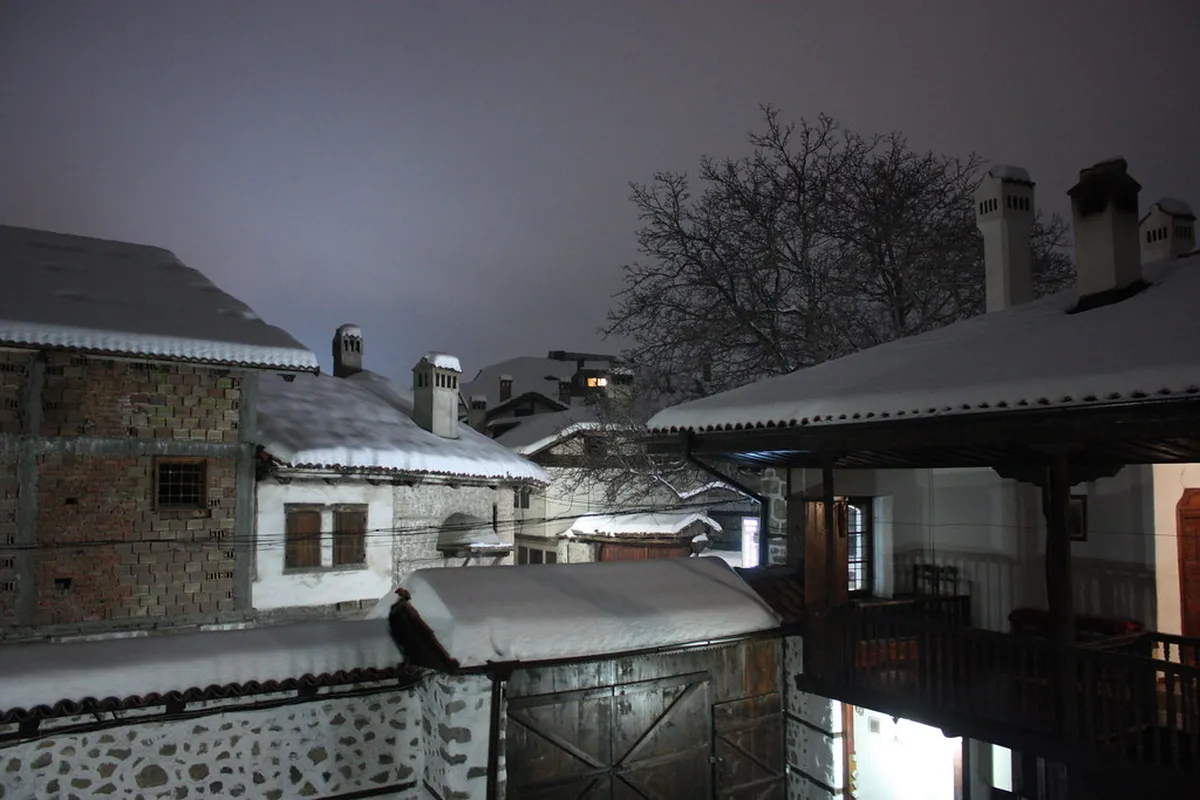
Seen from above, the complex forms a fortress-like ring: residential wings with wooden balconies enclose a courtyard planted with grapevines. The older 16th-century wing holds the monastic cells, cellars, and refectory (the monks' dining room); a taller 18th-century wing housed guests. A small stone ossuary near the gate, older than most of the complex, is worth a look on the way in.
The Church of the Nativity of the Virgin occupies the courtyard's center and takes its present three-apsed, domeless form from the 1732 reconstruction, though the foundations are older. Its dark tiled roof and heavy stone walls give little hint of the richness inside.
The wood-carved iconostasis, finished in the same 1732 campaign, is the church's most admired object: gilded vine-and-flower patterns wrap every panel in enough detail to hold visitors far longer than planned. The adjoining refectory, with its own faded Last Supper fresco, is a smaller but atmospheric stop many rush past.
The Miraculous Icon and Interior Murals
The monastery's most venerated object is the Miraculous Icon of the Holy Virgin Portaitissa, painted in 1790 by a monk from the Iviron Monastery as a copy of the original Portaitissa icon on Mount Athos - itself, tradition holds, recovered from the sea centuries earlier. Pilgrims still travel to pray before it, especially around the patron feast on 8 September.
Murals cover almost every surface of the narthex and naos in two waves: 16th-century scenes depicting Christ's post-Resurrection miracles, and more elaborate 18th-century compositions inside the nave, including 24 stanzas of the Virgin Mary's Akathist hymn. According to Historyhit.com, these are among the best-preserved fresco cycles of their kind in the region.
One exterior mural, the 'Ladder of Divine Ascent,' depicts monks climbing toward heaven while demons pull at them from below - a common Orthodox motif and one of the most photographed details on the outer wall.
The Melnik Pyramids and Nearby Hiking Trails
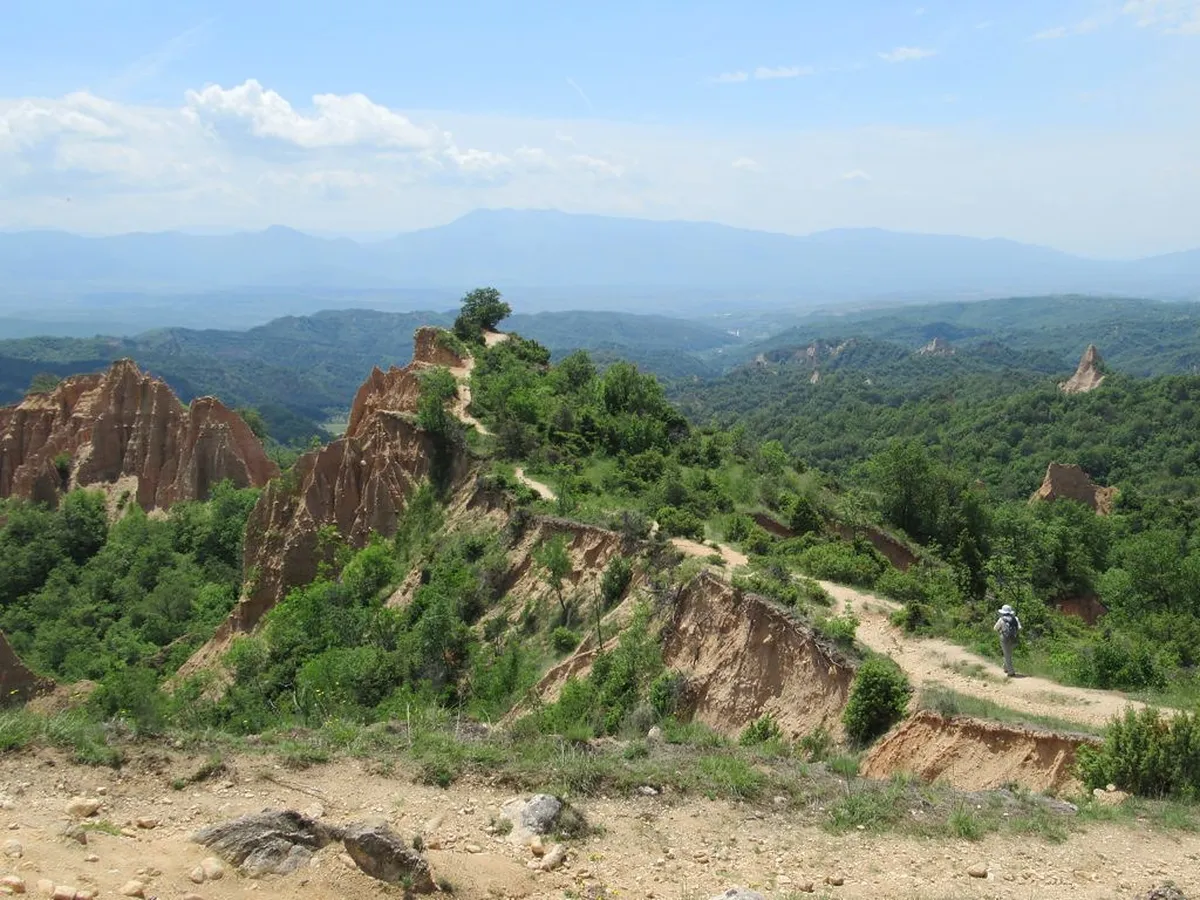
The natural scenery around the monastery draws as many visitors as the buildings themselves. Millennia of erosion carved the soft local sandstone into the towering Melnik Sandstone Pyramids (Melnik Earth Pyramids) Visitor Guide, a landmark protected since 1960, whose color shifts from pale gold to deep orange as the sun moves across the ridge.
A short walk from the gate leads to the grave of Yane Sandanski, the Macedonian revolutionary leader, and the small Church of Saints Cyril and Methodius, built in 1914 in his memory - both easy to combine with the eco-trail walk back to Melnik.
Trails range from a flat stroll along the ridge to steeper routes into the Pirin foothills. The ridge above gives the best panoramic view of the valley; carry water and wear boots with grip, since the sandy soil turns slippery in rain and summer heat alike.
Rozhen vs. Rila: Choosing Between Bulgaria's Great Monasteries
Rozhen inevitably gets compared to Rila Monastery, Bulgaria's UNESCO-listed showpiece about 120 km south of Sofia. Rila draws tour buses by the dozen, charges a parking fee and a separate museum ticket for the Hrelyu Tower exhibit, and can feel crowded by mid-morning even outside peak season. Rozhen charges nothing, sees a fraction of the traffic, and rarely requires more than a short wait to see the iconostasis up close.
The trade-off is scale - Rila's basilica and striped arcades are more dramatic, and its mountain setting feels more remote. Rozhen is smaller and quieter, but comes bundled with the sandstone pyramids and Melnik's wine cellars in a single afternoon, a combination Rila's location can't match.
For a Melnik or Bansko-based itinerary, Rozhen is the practical choice - a half-day loop with time for wine tasting. Rila deserves its own full-day trip from Sofia rather than a rushed combination.
Practical Tips for a Respectful Visit
Photography is strictly prohibited inside the main church to protect the frescoes and icons; the courtyard, exterior walls, and grounds are fair game, but look for a posted sign or ask a monk before raising your camera anywhere borderline.
8 September, the feast of the Nativity of the Virgin, is the monastery's biggest day of the year and draws large crowds - worth timing your visit around for the atmosphere, or avoiding if you'd rather have the courtyard to yourself. Any weekday morning outside that date is usually quiet.
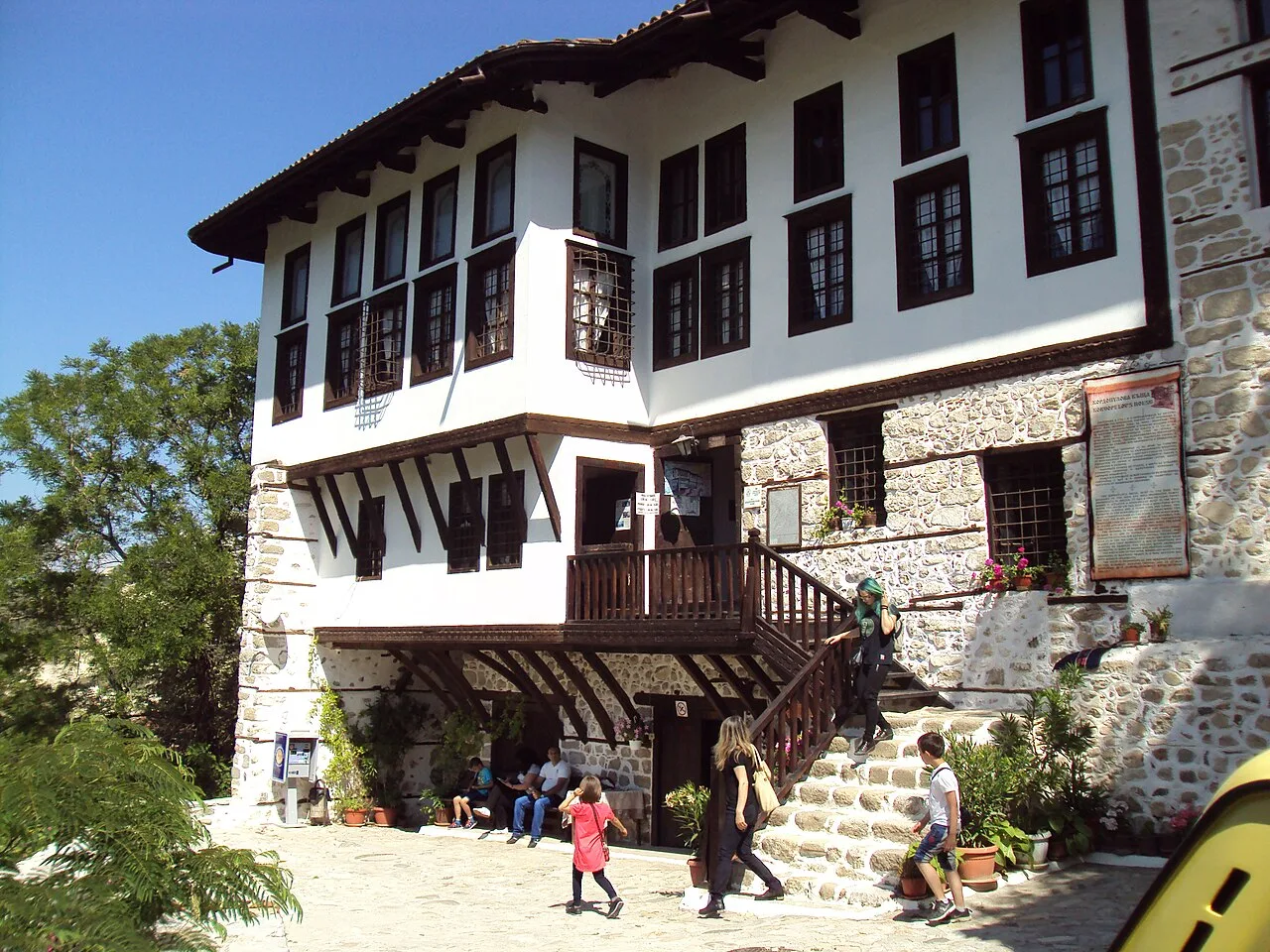
Pair the visit with the Kordopulov House Visitor Guide and the Melnik Museum of Wine Visitor Guide back in town - both a short drive away and part of a day that mixes faith, history, and wine into one of southern Bulgaria's most rewarding loops.
Continue planning: Use Melnik Attractions: Things to Do in Bulgaria's Smallest Wine Town to connect this guide with the rest of your Bulgaria itinerary.
Frequently Asked Questions
What is Rozhen Monastery?
Rozhen Monastery is the largest monastery in Bulgaria's Pirin Mountains, dedicated to the Nativity of the Mother of God. It sits near Rozhen village, about 6 km from Melnik and above the sandstone earth pyramids, and is one of the country's few well-preserved medieval monasteries.
Is Rozhen Monastery free to enter?
Yes. Entry is free and open to visitors year-round; donations toward the monastery's upkeep are welcome. Please dress modestly and respect that it is an active place of worship.
How old is the monastery?
Its origins reach back to the 13th century - the earliest evidence dates to the reign of Byzantine Emperor Michael VIII Palaiologos (1259-1282). After fire damage in the 17th century, it was rebuilt, with the main church completed in 1732.
What is Rozhen Monastery famous for?
It is celebrated for its richly painted 16th-18th-century frescoes, its intricately carved wooden iconostases, and its distinctive stained-glass windows, as well as a revered miraculous icon of the Virgin Mary kept in the chapel of Saints Cosmas and Damian.
Is this the same place as the Rozhen Observatory?
No. Rozhen Monastery is a medieval Orthodox monastery near Melnik in the Pirin Mountains. The Rozhen Observatory is a separate astronomical facility located in the Rhodope Mountains - a completely different site despite sharing the name Rozhen.
How do I get to Rozhen Monastery from Melnik?
The monastery is about 6 km from Melnik and reachable by road or public transport to Rozhen village. Many visitors prefer the scenic marked footpath that climbs through the Melnik Earth Pyramids, connecting the town directly with the monastery.
What else is near Rozhen Monastery?
The monastery overlooks the Melnik Earth Pyramids and is close to Rozhen village, where the revolutionary Yane Sandanski is buried. The wine town of Melnik, with its Kordopulov House and Revival architecture, is a short trip away.
Rozhen Monastery offers a unique window into the spiritual heart of the Pirin region. Whether you come for the history, the art, or the hiking, the experience is deeply rewarding. The combination of ancient murals and dramatic nature creates memories that last a lifetime.
Take the time to explore both the holy site and the nearby town of Melnik. Planning your visit with respect for local traditions ensures a smooth and meaningful trip. We hope this guide helps you discover the quiet beauty of the Nativity of the Mother of God cloister.
For more Melnik planning, read our Melnik Wine: Guide to Bulgarian Varietals & Wine Country and Rozhen Monastery Travel Guide guides.
For the latest official information, see the Rozhen Monastery (Nativity of the Mother of God) on Wikipedia and Rozhen Monastery (Nativity of the Mother of God) official site.