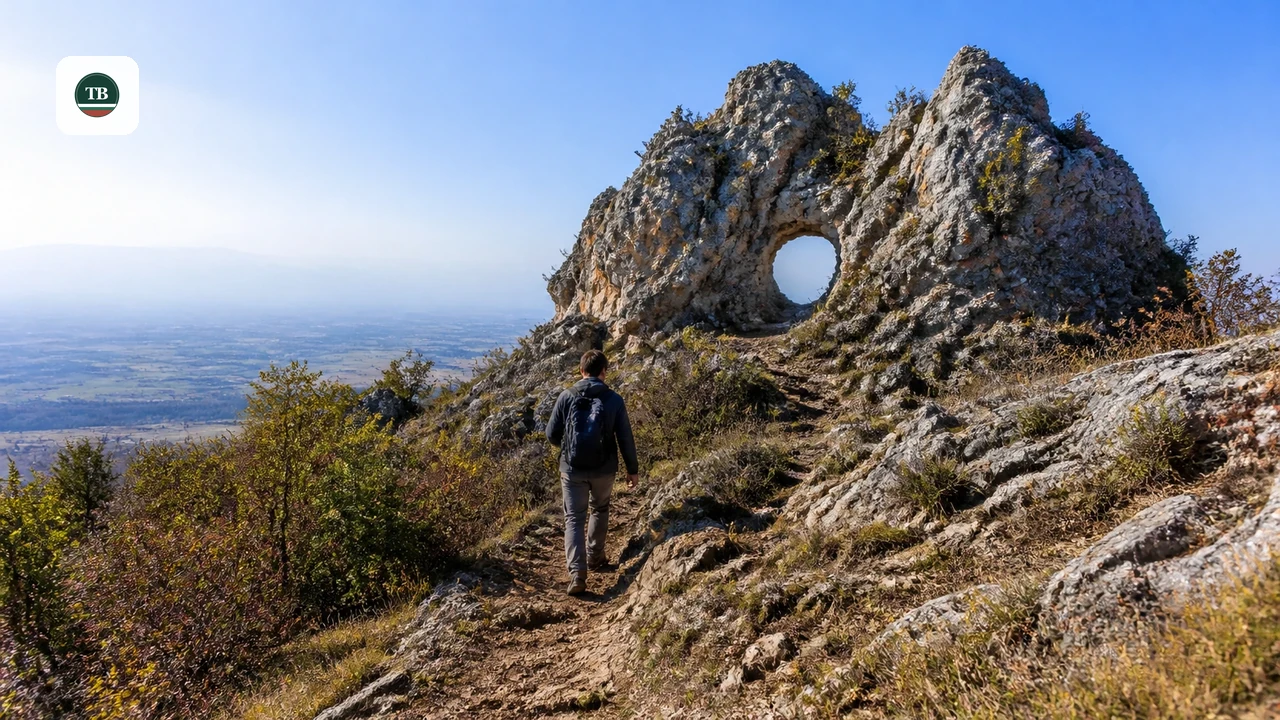
Sinite Kamani Nature Park, Sliven: A Complete Visitor Guide
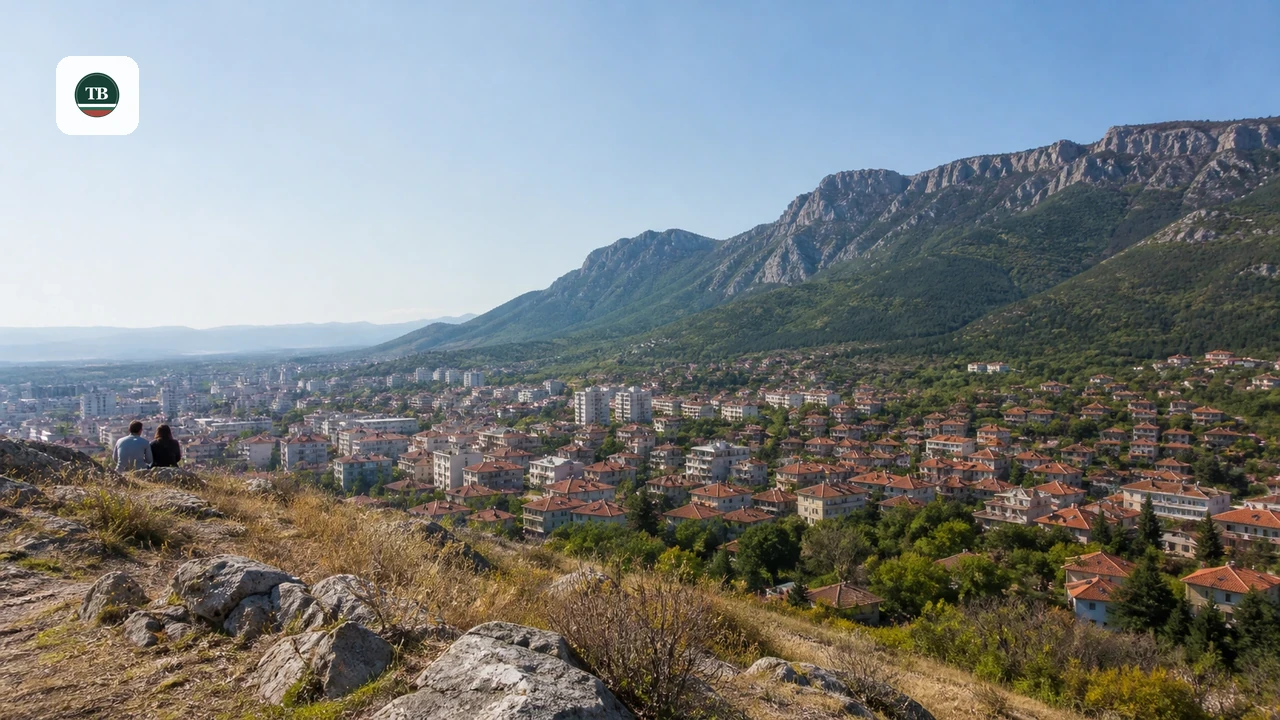
Last updated August 2026, Sinite Kamani Nature Park in Sliven protects 113.8 square kilometers of quartz-rock ridges rising directly behind the city center. The park's blue-gray tint comes from quartz porphyry in the rock face, most visible at sunset when low light hits the stone. This guide covers the Sliven-Karandila chairlift, the drive to the TV tower, and the marked trails to the Halkata rock arch.
Sinite Kamani Nature Park at a Glance
Sinite Kamani Nature Park sits in the Balkan Mountains immediately north of Sliven, with its southern edge touching the city's northern limits. Bulgaria's Ministry of Environment and Water established the park in 1980 to protect 113.8 square kilometers (43.9 square miles) of forest, cliff, and ravine terrain. IUCN category V status applies across the park. Its full territory also sits inside the Natura 2000 network, under the code Sinite Kamani BG0000164. Park boundaries also take in the smaller Kutelka Reserve, a separately noted pocket of limestone cliffs. Quartz porphyry gives the park's namesake rocks their color, a stone whose shade shifts from gray toward violet-blue depending on the angle and intensity of light. This effect peaks in the last hour before sunset. For more of the city beyond the park, see Sliven's other attractions.
| Metric | Detail |
|---|---|
| Area | 113.8 sq km (43.9 sq mi) |
| Highest point | Bulgarka Peak, 3,875 ft (1,181 m) — highest summit in the Eastern Balkan Mountains |
| Established | 1980 |
| Distance from Sliven | 0 mi — the park boundary meets the city's edge |
| Protected status | IUCN category V; Natura 2000 code Sinite Kamani BG0000164 |
Getting to Sinite Kamani Nature Park from Sliven
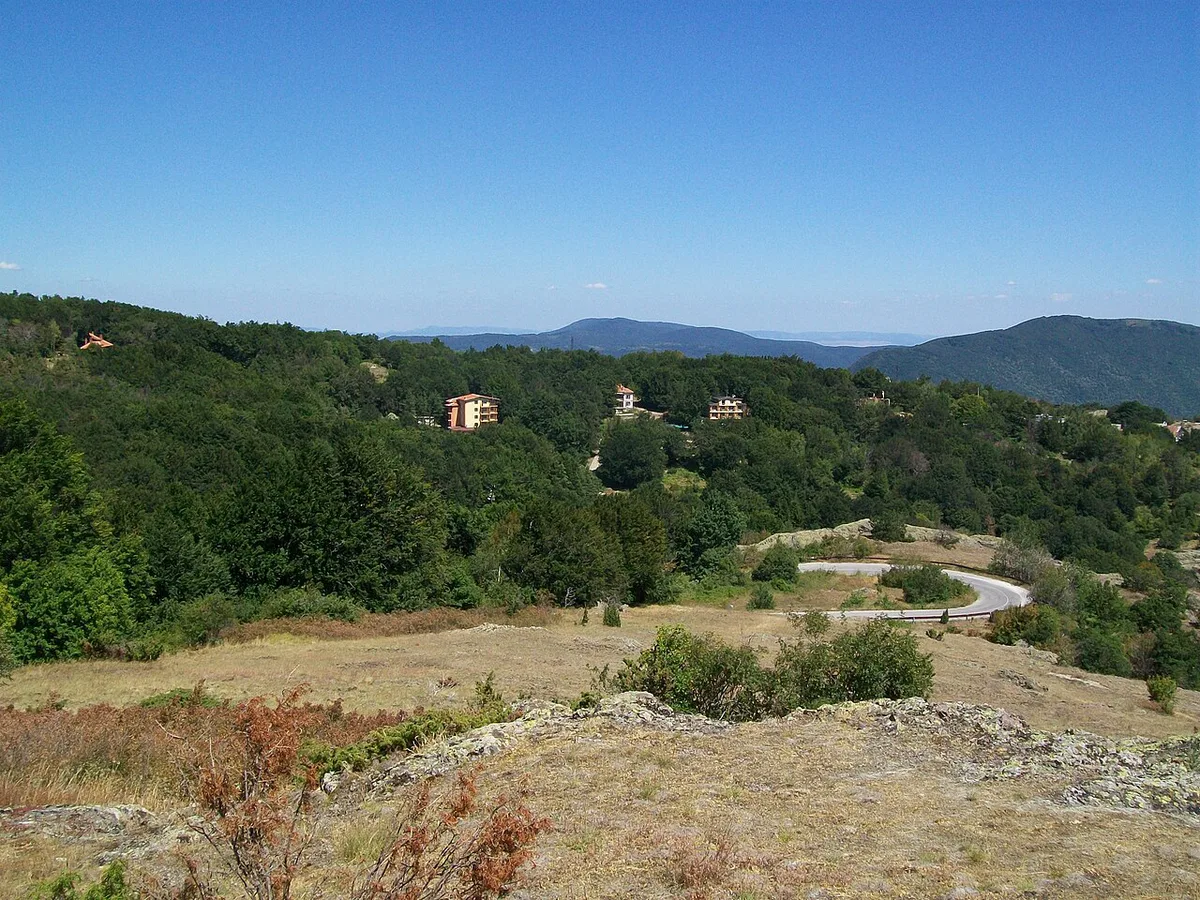
Three routes reach the park from central Sliven. Visit Bulgaria's tourism portal profiles the city as the base for exploring the Sinite Kamani massif. Each route suits a different kind of visit.
Sliven-Karandila's chairlift departs from a valley station in Sliven and carries riders up to the Karandila plateau. Cabins run open-air, with riders' legs dangling below the seat rather than enclosed in a cabin. Typical operating hours run roughly 8:30 to 16:00. Maintenance schedules shift between seasons, so confirm the current timetable locally before a visit. This ride trades flexibility for scenery, since cabins run on a fixed schedule and the last car down sets a hard limit on the day.
Driving covers the same elevation gain in about 15.5 miles (25 km) of switchback road that climbs past the TV tower toward Karandila. A car gives control over timing, which matters if the goal is catching the rocks at sunset rather than whatever slot the chairlift allows. Drivers connecting Sofia to the Black Sea coast often add this detour. See the Bulgaria road-trip route for how it fits into a longer loop.
Hikers can climb directly from the city center on the Haidushka Path, known locally as the Rebels' Path. Expect a steady climb with limited shade, suited to fit walkers with time to spare. Start early if the plan is a same-day round trip, since this route takes longer than either the chairlift or the drive.
Halkata Rock Arch and the Park's Other Landmarks
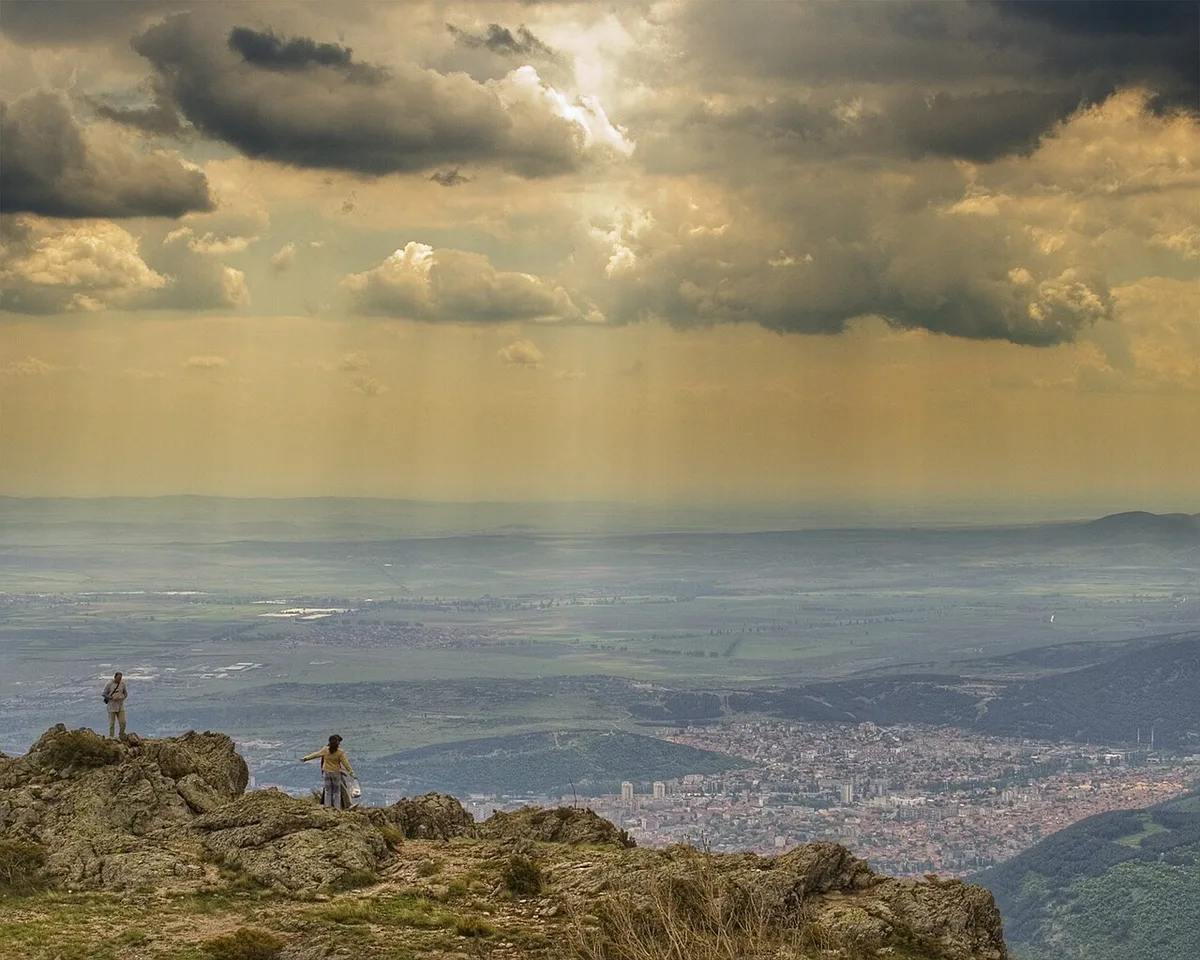
Halkata, meaning The Ring, is the park's most photographed landmark. It is a quartz arch about 26 feet tall (8 meters), with an opening roughly 6 feet wide (2 meters) that hikers walk through. Local legend holds that a young woman leapt through the ring to escape capture, a story residents still call the Maid's Jump. From the viewpoint near the arch, hikers get a clear look at Sliven and the chairlift's valley station below. Reaching the ring itself from that viewpoint takes about 40 minutes on foot, according to routes logged by hikers on Komoot.
Bulgarka Peak, at 3,875 feet (1,181 meters), is the highest point in the park and the highest summit in the Eastern Balkan Mountains. Its ridge trail crosses open ground with views across the Sliven Valley on clear days.
Futula Waterfall makes a good rest stop along several of the park's loop trails, with a spring-fed pool for refilling water bottles. Flow is strongest after spring snowmelt. By late August the falls often thin to a trickle or run dry, so plan an April-to-June visit if seeing water is the goal.
Kutelka Nature Reserve, folded into the park's boundaries, protects a stretch of sheer limestone cliffs distinct from the quartz porphyry that gives Sinite Kamani its name. Several marked loops approach viewpoints over the reserve without entering its restricted core.
At the foothills, the ruined Tuida Fortress marks history that predates the park by more than a thousand years. This site became part of the First Bulgarian Empire in the early 8th century, following the Byzantine-Bulgarian treaty of 716. Two fortress sections, a church, and a monastery survive today. Sliven's old town district guide continues this history where the fortress ruins leave off.
Numerous caves pock the massif, including Zmeevi Dupki, Haydushkata Peshtera, Bachvata, and Starite Dupki, though none have marked visitor infrastructure. Treat them as backcountry features rather than tourist stops. Other named rock formations along the trails include The Dolls, The Cask, and The Camel, weathered quartz shapes worth spotting between the main landmarks.
Hiking Trails by Difficulty
Trail difficulty in Sinite Kamani ranges from a one-hour stroll to a full-day mountain circuit. Komoot's community-logged routes give a reliable picture of distance, elevation gain, and typical hiking time.
The Futula Waterfall trail loop takes 5h 13m of hiking, but by late August the waterfall typically runs dry, making spring or early summer a better choice for this hike.
Haidushka Path's climb from the city adds extra time to any of these loop stats. Pair a plateau loop with the chairlift or a drive if a full day on foot is not the goal. For a broader view of trail options across the country, the hiking routes across Bulgaria's mountains guide compares regions beyond Sliven.
| Trail | Distance | Time | Elevation Gain | Difficulty |
|---|---|---|---|---|
| Halkata Rock Arch loop from Sliven | 1.5 mi (2.4 km) | 53 min | 490 ft (150 m) | Easy |
| Kutelka Reserve viewpoint loop from Sliven | 3.5 mi (5.6 km) | 2h 6m | 1,250 ft (380 m) | Moderate |
| Kutelka Reserve – Halkata loop from Kushbunar | 5.5 mi (8.8 km) | 3h 13m | 1,770 ft (540 m) | Moderate |
| Halkata Rock Arch – Karandila Lake loop from Sliven | 8.4 mi (13.5 km) | 4h 47m | 2,490 ft (760 m) | Moderate |
| Futula Waterfall – Halkata Rock Arch loop from Sliven | 8.7 mi (14.0 km) | 5h 13m | 2,850 ft (870 m) | Hard |
Karandila Resort Area: Where to Eat and Stay
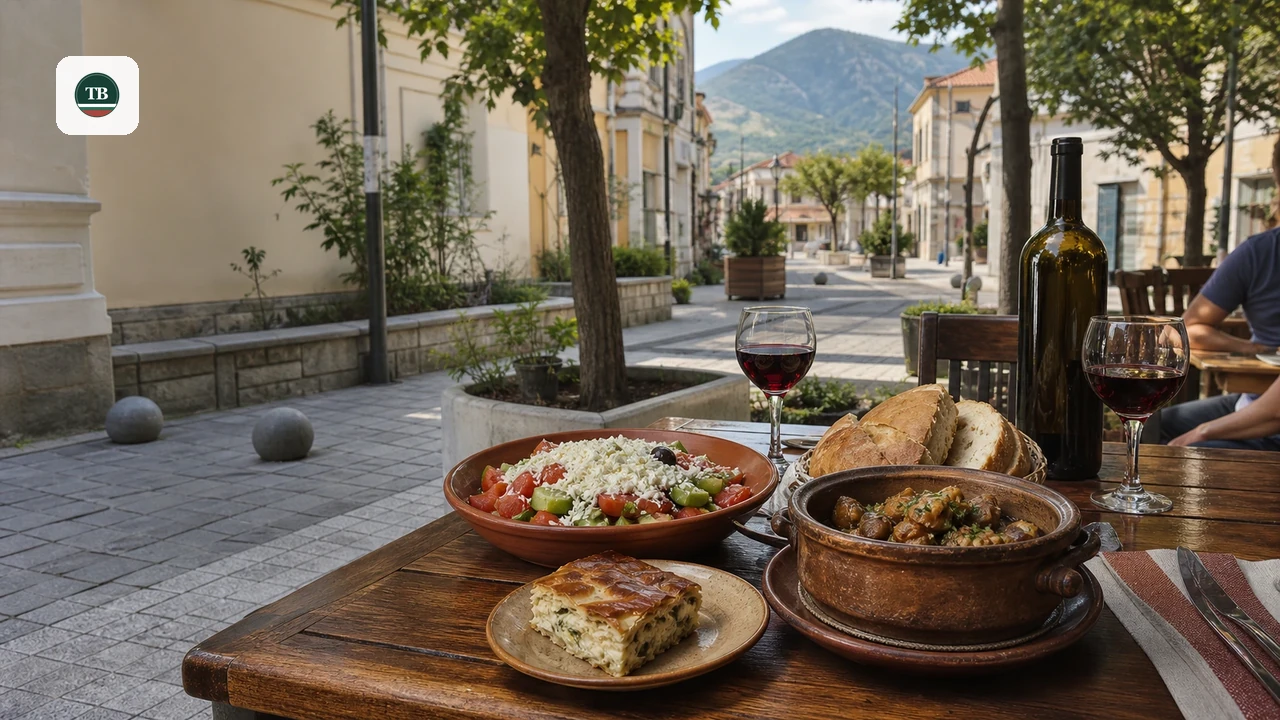
Karandila functions as the park's basecamp, with facilities clustered around the small reservoir known as Karandila Lake. A self-service restaurant sits beside the water, along with a spring-water fountain, a children's playground, and a climbing park. Its bakery has a local reputation for fresh bread, baked on site and sold alongside a small winery and snack bar. Sliven's wider wine and food scene extends beyond Karandila itself. The local food and wine scene guide covers other tasting stops in town. If bread and local products make good take-home gifts, the souvenir ideas from Bulgaria guide covers what packs well for the trip home.
For overnight stays, the Sinite Kamani Sport and Tourism Complex and the separate Ezeroto hostel cover a range of budgets near the lake.
Beyond hiking, the wider park supports paragliding, mountain biking, and winter skiing when snow conditions allow, based on the park's own listed activities.
- Iglika, Kapina, Lavandula, Zdravets, and Malina: wooden alpine-style houses inside the Sport and Tourism Complex
- Villa: a larger property within the same complex
- Edelweiss: an additional wooden-house option in the complex
- Ezeroto hostel: a separate, budget-oriented base near Karandila Lake
Wildlife and the Vulture Conservation Story
Deciduous forest covers roughly 90 percent of the park's area and is dominated by Crimean beech, a natural hybrid tree found across the Balkans. Some beech stands near Kushbunar are recorded at around 400 years old. Sinite Kamani also holds Bulgaria's northernmost population of kermes oak, along with rare species such as Urumov's tulip. More than 1,000 species of land plants grow within the park, and 43 of them appear in Bulgaria's Red Book of threatened species.
Rocky cliffs across the park provide nesting habitat for 20 species of diurnal birds of prey, including eastern imperial eagle, golden eagle, long-legged buzzard, and peregrine falcon. Egyptian vulture and Eurasian eagle-owl are among the additional raptors recorded here. A Natura 2000 listing, under the code Sinite Kamani BG0000164, protects this nesting habitat alongside the wider forest and cliff system.
Away from the cliffs, look for red deer, roe deer, and the occasional Eurasian otter along the park's streams. Cave systems support at least 12 bat species, including the greater mouse-eared bat and greater horseshoe bat. Reptile life includes Balkan green lizard, Balkan wall lizard, and two protected species, Greek tortoise and Hermann's tortoise.
Best Time to Visit and Planning Tips
Sunset gives the rocks their strongest blue-violet cast, so plan the drive or a late chairlift ride around golden hour if photography is the priority. Snow typically begins settling at mid-elevations by early November and can persist into March, so check trail conditions before a winter visit. Lower ravines trap summer heat, while the exposed ridge near Karandila stays windier and cooler than the valley floor. Pack a layer even on a hot day in Sliven.
A few planning mistakes are worth avoiding. Chairlift cabins run on a fixed schedule. Missing the last car down means a long walk back to the city, so confirm the final departure time before heading up. Wind picks up noticeably on the ridge above Halkata, more than in the sheltered trail sections below it, which surprises hikers dressed for calmer forest paths.
Dogs are generally welcome on the trails but should stay on a leash to protect nesting wildlife. Parking is available at the Karandila resort area and at several trailheads closer to Sliven. If a full day leaves time for more, the other day-trip options guide rounds out nearby stops. It also fits naturally into travel plans built around places worth visiting in Bulgaria, especially for travelers routing through the Balkan Mountains.
Bird Conservation and Responsible Wildlife Watching
Sinite Kamani’s cliffs are important nesting ground for birds of prey, so wildlife watching needs a little more care than a casual viewpoint stop. Conservation work in the Eastern Balkan landscape supports sensitive species, including Egyptian vultures and eastern imperial eagles. The park’s steep, quieter cliff faces are especially valuable during nesting season.
Bring binoculars or a telephoto lens rather than trying to approach birds. Stay on marked trails and established viewpoints. Avoid drones, loud music, and climbing near cliff edges, as disturbance can cause birds to abandon a nest site.
- Watch from a distance, particularly around Kutelka’s cliffs.
- Choose early morning for calmer air and better bird activity.
- Keep dogs leashed near open ridges and nesting habitat.
If you spot an injured bird or an active nest close to a trail, do not handle it. Note the location and report it to park staff or a local conservation organization.
For trip-planning details, see Sinite Kamani Nature Park - Wikipedia.
Frequently Asked Questions
How do you get to Sinite Kamani Nature Park from Sliven?
Three main options connect Sliven to the park. Take the Sliven-Karandila chairlift, drive about 15.5 miles (25 km) past the TV tower, or hike the Haidushka Path directly from the city. Choose the drive for sunset flexibility, or the chairlift for a faster, scenic ride up.
Why are the rocks at Sinite Kamani blue?
Color comes from quartz porphyry in the rock face. Its tone shifts from gray toward violet-blue depending on the angle and intensity of light, an effect strongest around sunset.
How long does it take to reach Halkata (The Ring) on foot?
From the viewpoint near the chairlift's upper station, hikers commonly reach the ring in about 40 minutes, based on routes logged by the Komoot hiking community. Its shortest loop from Sliven covers about 1.5 miles (2.4 km) round trip.
When is the best time to visit Sinite Kamani Nature Park?
Spring and autumn bring milder temperatures and clearer light for photographing the blue-rock effect. Visitors in late August should expect Futula Waterfall to run thin or dry, since its flow depends on spring snowmelt.
Are dogs allowed on the trails?
Yes, dogs are generally welcome on the marked trails. Keep them on a leash to protect the park's nesting birds of prey and other wildlife.
How high is Bulgarka Peak?
Bulgarka Peak reaches 3,875 feet (1,181 meters), making it the highest summit in the Eastern Balkan Mountains. It sits within the park's northern ridge, the highest and steepest section of the massif.