
Bulgarian Traditions and Customs: A 2026 Guide
From the martenitsa on 1 March to barefoot fire-dancing in June, discover Bulgaria's living customs, folk rituals, and cultural practices that shape everyday life.
On this page
Bulgarian Traditions and Customs: Living Culture From Martenitsa to Fire-Dancing
Bulgaria is one of Europe's oldest continuously inhabited lands, and its customs reflect that depth — layered across Thracian, Byzantine, Ottoman, and Slavic influences yet recognisably alive today. On the first day of March, millions of Bulgarians exchange red-and-white yarn ornaments. In January, fur-clad dancers with horned masks charge through village streets shaking bells loud enough to scatter evil spirits. In June, devotees in a remote Strandzha mountain village step barefoot onto glowing embers in a state of trance. These are not museum pieces: they happen every year, observed by ordinary people across the country.
This guide covers Bulgaria's living customs and cultural practices — from daily hospitality rules and the all-important name day (imen den) to the horo circle dance and the quirky head-gesture reversal that confuses almost every first-time visitor. For the full calendar of Bulgarian public holidays and major festivals with exact annual dates, see our guide to Bulgaria's festivals and public holidays.
Bulgarian Customs at a Glance
The table below gives a quick orientation to Bulgaria's most distinctive traditions. Detailed sections follow for each one.
| Custom | What It Is | When |
|---|---|---|
| Baba Marta / Martenitsa | Exchange of red-and-white yarn charms for spring luck | 1 March (fixed) |
| Kukeri | Men in terrifying beast masks and bells drive off evil spirits | January (Surva festival: 16–25 Jan 2026) |
| Nestinarstvo | Barefoot fire-dancing on glowing embers in a trance state | 3–4 June (feast of Sts. Constantine & Helena) |
| Imen den (name day) | Orthodox-calendar personal feast; celebrant hosts guests | Varies by name (see Orthodox calendar) |
| Horo | Chain/circle folk dance at every celebration | Year-round (weddings, holidays, village fairs) |
| Bread & salt welcome | Round pita + salt presented to honored guests | Any formal welcome |
| Head gesture reversal | Upward tilt = no; side-to-side = yes | Always |
| Velikden (Orthodox Easter) | Midnight liturgy, red eggs, kozunak bread, roast lamb | 12 April 2026 |
| Koleda (Christmas Eve) | Plant-based odd-dish feast, badnik log, koledari carols | 24–25 December |
| Rose harvest | Dawn rose-picking, rosa damascena, rose festival | Late May–mid June; festival 5–7 June 2026 |
Baba Marta and the Martenitsa: Bulgaria's Spring Ritual
On 1 March every year — the feast of Baba Marta (Grandma March), the capricious spirit who controls spring weather — Bulgarians greet each other with martenitsi: small ornaments of intertwined red and white yarn. The most common forms are tassels, woven bracelets, and the paired dolls Pizho (white, male) and Penda (red, female). Red symbolises health, blood, and fertility; white represents strength, purity, and happiness. Friends, family members, and colleagues exchange them at the start of March, and you will see Bulgarians wearing them pinned to jackets or tied around their left wrist throughout the month.
The custom ends when the wearer spots the first stork flying north or sees the first blossoming tree of spring — at which point the martenitsa is tied to a branch as an offering. Because the timing depends on nature rather than the calendar, people might wear theirs into late March or April depending on the year and region. In 2017, UNESCO inscribed the practice on its Representative List of Intangible Cultural Heritage of Humanity, jointly with Romania and North Macedonia where parallel spring-yarn traditions exist under different names. Our dedicated guide to martenitsa covers where to buy them, how to give them correctly, and what visitors can expect on 1 March.
Kukeri: The Bell-Shaking Beast Dancers of January
Each January, men in some of the most spectacular costumes in Europe take to the streets of Bulgarian towns and villages. Kukeri wear enormous animal-fur suits, carved wooden masks fitted with horns and animal faces, and wide belts hung with heavy cast-iron bells that ring out with every step. Headdresses can reach 60 centimetres tall. The ritual is rooted in pre-Christian apotropaic practice: the thundering noise and fearsome appearance are meant to banish evil spirits and call down a good harvest for the year ahead.
Village kukeri rituals take place across Bulgaria in the period around Epiphany in early January, but the largest international gathering is the Surva Masquerade Festival in Pernik, a short drive west of Sofia. In 2026, Surva ran from 16 to 25 January in an extended two-weekend format — the first time in the festival's history — under UNESCO patronage, with groups from France, Italy, Portugal, Croatia, Greece, the USA, and beyond joining Bulgarian performers. UNESCO inscribed the "Surova folk feast in the Pernik region" on its Representative List in 2015. Our full kukeri guide covers how to reach Pernik, what to expect at Surva, and how village kukeri rituals differ from the international festival.
Don't confuse the Surva festival (a large international event held in Pernik in late January) with the smaller village kukeri rituals that happen earlier in January. Both are authentic — they serve different scales and audiences.
Nestinarstvo: Barefoot Fire-Dancing in the Strandzha
Among Bulgaria's UNESCO-inscribed cultural traditions, nestinarstvo is arguably the most visually arresting. On the feast day of Saints Constantine and Helena — 3 to 4 June — the village of Bulgari in the Strandzha Mountains hosts the only fully authentic nestinarstvo panagyr still performed in Bulgaria. The ritual begins in the morning with a procession bearing consecrated icons to a holy-water spring, accompanied by the steady rhythm of a drum and the drone of a gaida (goatskin bagpipe). Holy water and candles are distributed to the gathered crowd. At nightfall, the nestinari — individuals believed to carry a special devotional calling — enter a trance state and then dance barefoot across a bed of glowing embers.
The practice is devotional, not theatrical. UNESCO inscribed nestinarstvo on its Representative List in 2009. Historically the tradition was maintained in six Strandzha villages, but the authentic form now survives primarily in Bulgari. Commercial "fire dance shows" are offered at tourist restaurants across Bulgaria — these are entertainment inspired by the tradition, not the ritual itself. If you plan to witness the real panagyr, the feast falls on 3–4 June annually.
Restaurant fire dance performances across Bulgaria are tourist entertainment inspired by nestinarstvo, not the authentic ritual. The only genuine ceremony is the annual panagyr in the village of Bulgari in the Strandzha Mountains each 3–4 June.
Name Days: The Celebration the Celebrant Hosts
The Orthodox Church calendar assigns a saint's feast day to nearly every given name, and in Bulgaria the imen den (name day) is often observed as seriously as — or more than — a birthday. The key cultural difference: the person whose name day it is acts as host, not guest. They open their home, prepare food and drink, and receive visitors throughout the day. Guests bring flowers in odd numbers (always avoid chrysanthemums, lilies, or gladioli, which are reserved for funerals) or bring a box of sweets. The correct greeting is "Честит имен ден!" (Chestit imen den! — Happy name day!).
Several name days carry particular cultural weight. Gergiovden on 6 May (St. George's Day) is simultaneously Bulgaria's Armed Forces Day and the name day of all Georgis. Tsvetnitsa, or Flower Names' Day, falls on Palm Sunday — one week before Orthodox Easter — and is celebrated by everyone with a flower-derived name: Tsvetelina, Violeta, Rosa, Lilyana. In 2026, Orthodox Easter falls on 12 April, placing Tsvetnitsa on 5 April 2026. Trifon Zarezan on 14 February is both St. Valentine's Day and the wine growers' celebration, honouring all men named Trifon. For a full list of public and religious holidays, see our Bulgaria festivals and public holidays guide.
The Nod That Means No: Bulgarian Gestures and Hospitality
No cultural briefing on Bulgaria is complete without addressing the head gesture reversal that catches almost every foreign visitor off guard. In Bulgaria, a slow upward tilt of the head — what most Europeans and North Americans would read as a nod of agreement — typically means no. A side-to-side shake of the head, which Westerners associate with disagreement, typically means yes. An additional "no" signal is a sudden downward jerk of the head accompanied by a click of the tongue. The origins of this inversion are debated; an Ottoman-era resistance theory is popular but unverified.
That said, the convention is not absolute. Many younger urban Bulgarians who speak foreign languages will code-switch to the Western gesture system when addressing foreigners. In ambiguous situations, listen for the verbal да (da = yes) and не (ne = no) rather than relying on the head movement alone. The safest rule: when in doubt, ask for verbal confirmation.
Bulgarian hospitality runs deeper than gestures. Formal arrivals are greeted with bread and salt — a round ritual pita loaf with a bowl of salt resting on it; the guest breaks off a piece and dips it. At the dinner table, wait for the hostess to signal before eating, defer to elders, and accept second helpings graciously: repeated refusals read as rejection. Glasses are kept refilled — leave a small amount in the glass only if you genuinely want no more. Meals routinely last three to four hours. If invited to a Bulgarian home, bring flowers for the hostess and a bottle of spirits for the host.
The Horo and Folk Music: Bulgaria's Communal Beat
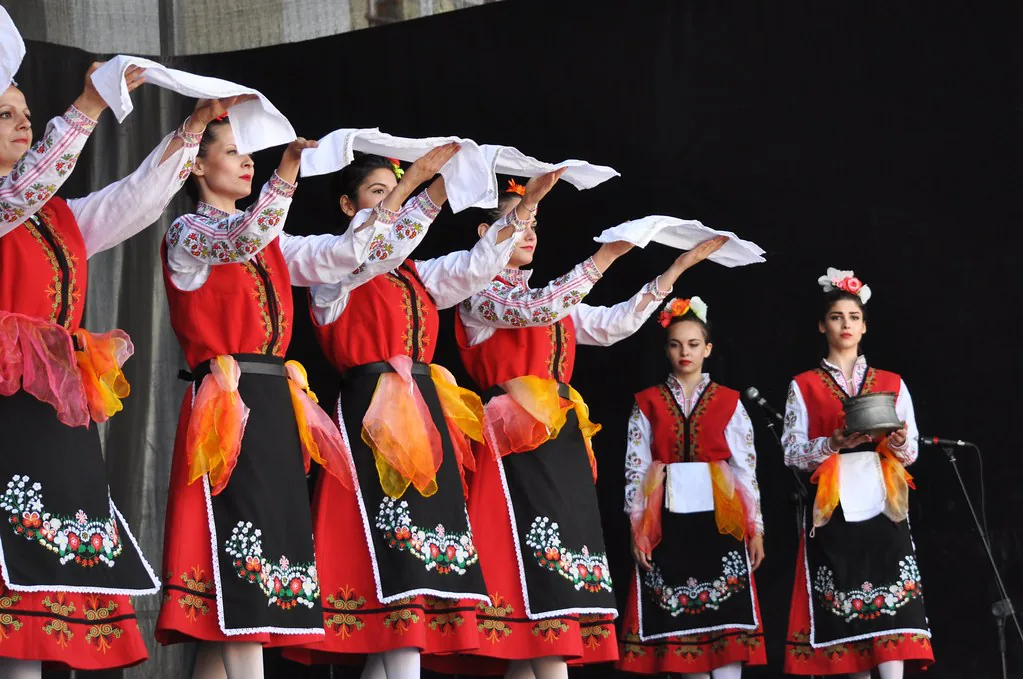
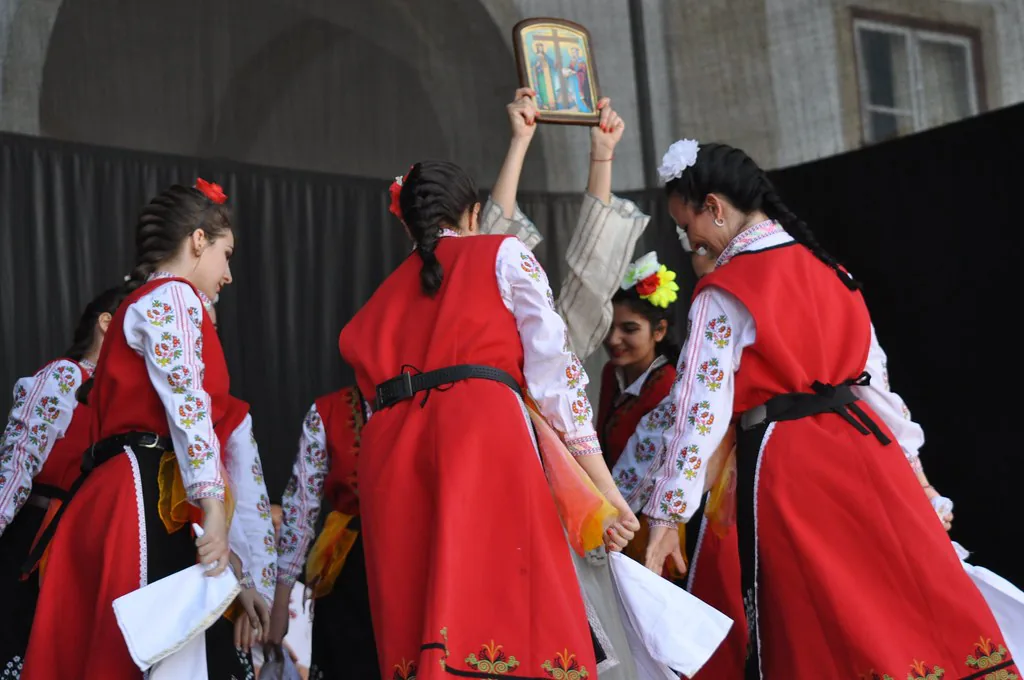
At weddings, name days, village fairs (sabori), and national celebrations, the moment the music starts, Bulgarians form a horo — a circle or open chain of dancers linked by hands or shoulders, all facing inward. The defining characteristic of Bulgarian folk music is its use of irregular time signatures: 7/8, 9/8, and 11/16 rhythms that feel asymmetric to ears trained on 4/4 music. Virtually every Bulgarian over the age of five can dance a basic horo. Regional varieties proliferate: the pravo horo is the simplest straight-chain form; the rachenitsa is a solo or couples dance in 7/8 time with complex footwork that can become competitive; the kopanitsa runs in 11/16 and is danced in parts of the Rhodope Mountains.
The instruments that drive these dances are equally distinctive. The gaida (goatskin bagpipe) produces a continuous drone beneath the melody. The kaval is an end-blown open flute with a haunting, breathy tone. The gadulka is a bowed string instrument held upright against the chest. The tupan, a large double-headed bass drum, provides the foundational beat. In 2025, UNESCO added bagpipes and bagpipe playing in Bulgaria to its Representative List of Intangible Cultural Heritage — the ninth Bulgarian element on the list. Bulgaria's full UNESCO ICH portfolio also includes the Bistritsa Babi women's polyphonic choir (2008), the Chiprovtsi carpet-making tradition (2014), the Festival of Folklore in Koprivshtitsa (2016), the Bulgarian Chitalishte community cultural centres (2017), and Visoko multipart singing from Dolen and Satovcha (2021).
Orthodox Easter and Christmas: The Ritual Year
Bulgaria follows the Julian calendar calculation for Orthodox Easter, which frequently places it on a different date from Western Easter. In 2026, Orthodox Easter (Velikden — literally "Great Day") falls on Sunday 12 April. The preceding 40-day Great Lent is observed by many Bulgarians as a strict fast excluding meat, fish, dairy, and eggs. The most visually memorable Easter custom is the painting of red eggs on Clean Thursday (the Thursday before Easter Sunday) — the eggs are then knocked together in the chukvanye na yaytsa game, with the uncracked egg promising its owner good luck for the year. The Easter table centres on roast lamb and kozunak, a rich braided sweet bread. The midnight liturgy on Holy Saturday is the emotional peak: the priest proclaims "Христос воскресе!" (Christ is risen!), the congregation replies "Воистину воскресе!" (Truly He is risen!), and Bulgarians attempt to carry their lit candles home still burning as a sign of blessing.
Christmas (Koleda) places its ritual heart on Christmas Eve, 24 December (Budni vecher). By tradition the evening meal contains only plant-based dishes — it marks the end of a 40-day Advent fast — and the number of dishes on the table must be odd: seven, nine, or eleven. An even number is considered unlucky. The table is left untouched overnight so the spirits of ancestors can eat. The ceremonial badnik oak log is placed in the fireplace and kept burning until morning. Groups of young men called koledari process house-to-house in folk dress, singing koleda carols to bless each household; householders give them food and small amounts of money. On New Year's Day, children continue the custom as survakane: they tap adults with decorated cornel-wood sticks (survacharki) while reciting blessings for health and prosperity in the coming year. For more on Bulgarian food traditions served at these celebrations, see our Bulgarian food guide.
The Rose Harvest: Bulgaria's Fragrant Heritage
Each year from late May to mid-June, the Rose Valley around Kazanlak in central Bulgaria fills with the scent of Rosa Damascena. Bulgaria is among the world's largest producers of rose otto (attar of roses), and large-scale cultivation of the Damask rose in this valley dates to the 17th and 18th centuries, after the variety arrived via Persia, Syria, and the Ottoman trade networks. Harvesting takes place every morning between roughly 5 and 10 AM, before the heat of the day volatilises the essential oils — meaning the entire season's work happens in a few short weeks and in the early morning hours.
The Rose Festival in Kazanlak is typically held the first weekend of June; in 2026 the main celebration runs 5 to 7 June, featuring a rose-picking ritual in surrounding villages, a grand parade, and the crowning of the Rose Queen. The nearby Thracian Tomb of Kazanlak — a UNESCO World Heritage Site inscribed in 1979 — is worth combining with a rose-season visit. Our full guide to Rose Valley and Kazanlak covers the harvest calendar, how to join a picking session, and travel logistics from Sofia and Plovdiv.
For a very different kind of Bulgarian heritage landmark, the brutalist Buzludzha Monument — the UFO-shaped former Communist Party congress hall perched at 1,441 metres in the Balkan Mountains near Shipka Pass — sits roughly an hour's drive from Kazanlak and can be combined into a central Bulgaria road trip. Access policies at Buzludzha remain variable in 2026; check current conditions before visiting.
Frequently Asked Questions
What is the martenitsa tradition in Bulgaria?
On 1 March each year, Bulgarians exchange martenitsi — small red-and-white yarn ornaments symbolising health, strength, and the arrival of spring. Recipients wear them on the left wrist or lapel until they see the first stork or blossoming tree of spring, then tie the martenitsa to a branch as an offering. The practice was inscribed on UNESCO's Intangible Cultural Heritage list in 2017.
Do Bulgarians really nod their head to mean no?
Yes — in Bulgaria a slow upward tilt of the head typically signals no, while a side-to-side shake means yes, the reverse of most Western conventions. The inversion is not universal: many younger Bulgarians who speak foreign languages switch to the Western gesture system with foreigners. When in doubt, listen for the verbal да (da = yes) or не (ne = no) to be sure.
What is the kukeri ritual and when does it happen?
Kukeri is an ancient Bulgarian masquerade ritual in which men dress in enormous fur suits, horned carved-wood masks, and heavy bell belts to drive away evil spirits and summon a good harvest. Village rituals take place in early January, while the major international Surva Masquerade Festival is held in Pernik in late January — in 2026 it ran from 16 to 25 January. UNESCO inscribed the Surva tradition in 2015.
What is nestinarstvo and where can you see it?
Nestinarstvo is a sacred Bulgarian ritual in which devotees enter a trance and then dance barefoot on glowing embers. The only fully authentic ceremony takes place annually on 3–4 June in the village of Bulgari in the Strandzha Mountains, on the feast of Saints Constantine and Helena. It was inscribed by UNESCO in 2009. Commercial fire-dance shows at tourist restaurants across Bulgaria are entertainment, not the authentic ritual.
How important are name days in Bulgaria compared to birthdays?
Name days (imen den) are often observed as seriously as birthdays in Bulgaria — and sometimes more so. Unlike Western birthday customs, the person whose name day it is acts as the host, opening their home and providing food and drink for guests. Visitors bring flowers in odd numbers (avoiding funeral flowers such as chrysanthemums) or sweets, and greet the celebrant with "Честит имен ден!" (Chestit imen den!).
Bulgarian culture rewards patience and curiosity. The head-gesture reversal, the name-day hospitality customs, the pre-dawn rose harvest — none of these are performance for tourists; they are woven into ordinary Bulgarian life. Understanding them before you arrive transforms what might otherwise feel like confusion or awkwardness into moments of genuine connection with the people you meet.
For places to put this cultural knowledge into practice, start with Sofia, where kukeri performances, name-day café gatherings, and folk music venues are all within easy reach, or explore Bulgaria's best destinations to plan a trip that aligns with the customs calendar — rose season in the Valley, Surva in Pernik, or Velikden in a village monastery setting.