
Martenitsa & Baba Marta Day: Bulgaria's Spring Tradition 2026
Discover the martenitsa tradition — Bulgaria's red-and-white spring charm exchanged on Baba Marta Day, March 1, and why it was inscribed on the UNESCO heritage list.
On this page
Martenitsa Explained: Bulgaria's Red-and-White Spring Tradition
Every year on March 1, Bulgarians across the country — and millions in the diaspora abroad — exchange small red-and-white woven charms called martenitsi. These bracelets, brooches, and tassels are tied to wrists, pinned over hearts, and hung from door handles and the branches of young trees. The gesture marks Baba Marta Day, one of the most distinctive and warmly felt moments in the Bulgarian calendar, and it carries with it a tradition that predates the Bulgarian state by centuries.
For travellers visiting Bulgaria in late February or early March, the martenitsa is impossible to miss: street vendors appear on virtually every Sofia corner, shop windows fill with red-and-white displays, and by March 2 the city's park trees are already dotted with charms tied there by people who have spotted their first blossoming branch. This guide explains what a martenitsa is, the folklore behind it, how the tradition works from start to spring removal, and where you can buy or experience it as a visitor.
What Is a Martenitsa?
A martenitsa (мартеница, plural martenitsi) is a small adornment made from twisted wool or cotton threads in red and white. The two colors are inseparable from the object's meaning: red represents vitality, passion, and the life force, while white represents purity, new beginnings, and the retreating snow of winter. Worn together, they embody the balanced forces of the season turning — winter releasing its grip, spring pressing forward.
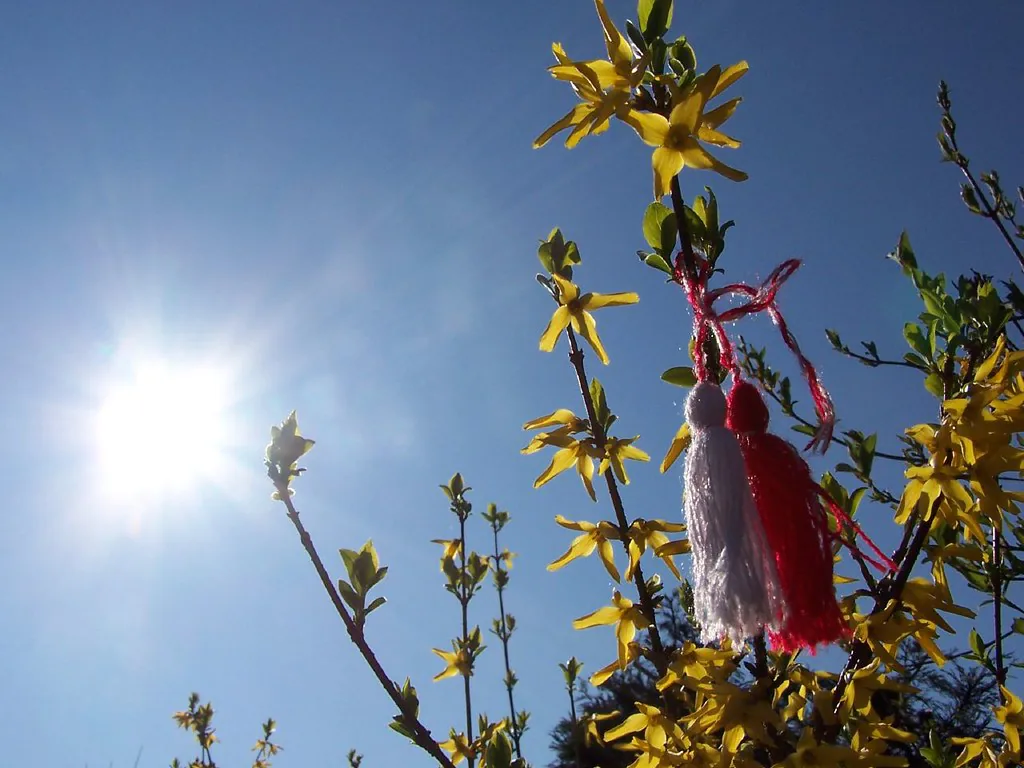
The most iconic figurative form is the paired dolls known as Pizho and Penda. Pizho is the male figure, predominantly white; Penda is the female, predominantly red and identified by her small skirt. They represent complementary opposites — male and female, strength and purity, active and receptive — and tradition sees them as symbolic newlyweds, carrying meaning around fertility, harmony, and the promise of new beginnings. They hang from the twisted thread ends of the bracelet form and are the version most commonly depicted in greeting cards and souvenir imagery. Beyond the Pizho-and-Penda pair, martenitsi also come as plain braided bracelets, knotted tassels, and shaped brooches; the visual diversity is wide, but the red-and-white color rule is universal.
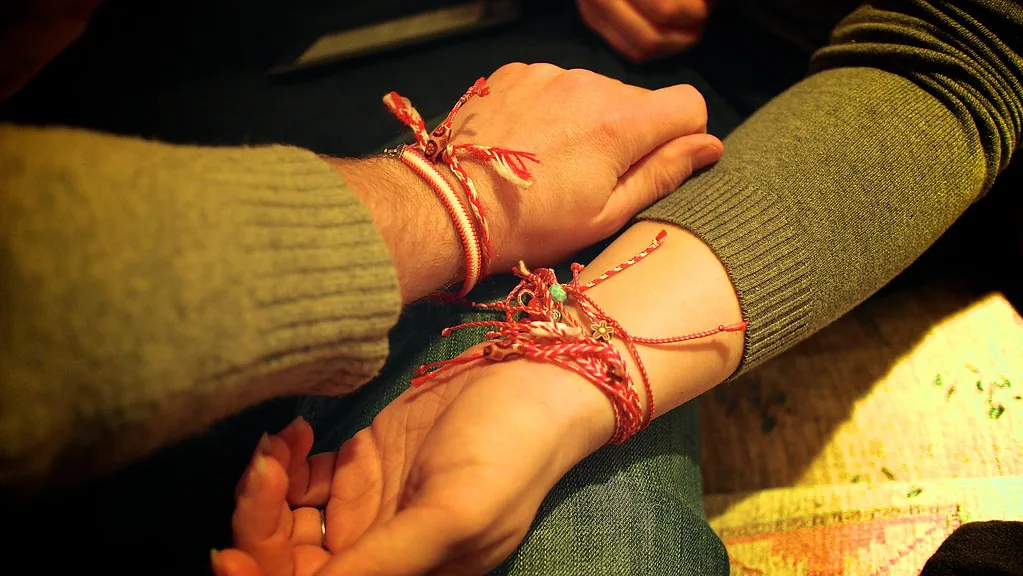
Martenitsi are not jewelry in the commercial sense — they are gifts. Folk tradition holds that a martenitsa should be received, not self-purchased, gifted between family members, friends, colleagues, and neighbours as a wish for health and happiness. In practice, millions of martenitsi are sold at street stalls and bought for gifting (or for one's own wrist), and more than 15 million were exchanged across Bulgaria in 2020 alone. The gifting culture is the point: the charm carries the good will of the person who tied it on.
Baba Marta Day: March 1 Every Year
The tradition centres on March 1, a date known as Baba Marta Day (Ден на Баба Марта). The name translates as "Grandmother March" — Baba Marta is a mythological figure, a temperamental old woman whose volatile moods are said to explain March's notoriously unpredictable weather. When she smiles, the sun comes out and warmth returns; when she is irritated, cold snaps snap back. She is neither goddess nor saint, but a personification of the month itself: capricious, powerful, and ultimately the herald of spring.
In 2026, Baba Marta Day fell on a Sunday, March 1. Street vendors and market stalls in Sofia were active through March 1 and 2, with exchanges documented across the country. The day is not a public holiday, but it is observed with the intensity of one: workplaces exchange martenitsi in the morning, children bring them to school, and the gifting continues through the first days of March.
Bulgaria has no shortage of memorable celebrations — if you want to see the full sweep of the country's festive calendar, the guide to Bulgaria's festivals and public holidays covers the year from Baba Marta through to the wine harvest and beyond. But Baba Marta Day stands apart because it is participatory rather than spectator-based: on March 1, almost every person you meet will be wearing a martenitsa, and many will give you one.
How and When to Wear a Martenitsa — and When to Remove It
A martenitsa received on March 1 is tied around the left wrist (the most common placement), pinned to clothing over the heart, or hung at home on a door handle or on the branch of a young tree. It is worn continuously from that point — not a one-day accessory, but a charm that stays with you until spring itself signals it is time to let go.
The removal moment is determined not by a calendar date but by a sign from nature. There are three widely accepted spring signals that tell you the martenitsa's work is done:
- Seeing a stork returning from its winter migration
- Seeing a swallow
- Seeing a blossoming or fruit tree in flower
In practice, Sofia residents most often remove their martenitsi when blossoming trees appear in parks — cherries and plums typically bloom between mid-March and early April depending on the year and the region. The stork sighting is more common in rural and agricultural areas. There is no fixed deadline, though some people cite the end of March as a loose outer boundary.
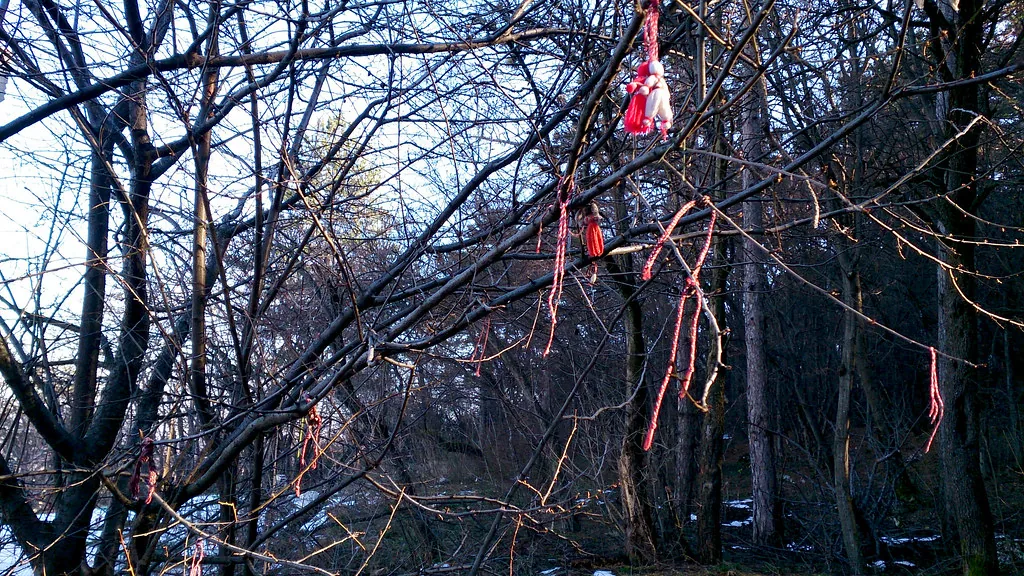
Once you remove the martenitsa, the tradition specifies what to do with it. The most common modern custom is to tie it to the branch of a fruit tree or blossoming tree — this is believed to transfer the health and good fortune carried in the charm to the tree, encouraging a fruitful season. The older, rural custom is to place the martenitsa under a stone and check the following day: a larva or worm underneath predicts a healthy and prosperous year; an ant signals hard work but eventual success; a spider suggests difficult months ahead. In agricultural communities, ants under the stone predicted many lambs for the season, while a beetle or worm predicted calves. A regional variation involves throwing the martenitsa into a flowing river, for life's smooth progression. All three customs share the same logic: the charm has absorbed your winter heaviness and now releases it, offering something back to the natural world.
If you visit Sofia's South Park or Borisova Gradina in mid-to-late March, look at the park trees — by then many branches will be festooned with hundreds of martenitsi tied there by city residents who spotted their first spring blossom. It is one of the most visually striking and quietly moving sights the city offers in spring.
The Folklore and Origins of the Martenitsa
The most widely told origin legend connects the martenitsa to Khan Asparuh, who founded the Bulgarian state in 681 AD. According to the folk narrative, Asparuh sent a falcon carrying a white thread to his sister to announce a military victory. An arrow struck the bird mid-flight, and the white thread became stained with the falcon's blood, merging white and red into a single strand. It is a vivid story and it lodges in the memory — but it is a folk etymology, not a verified historical record, and its purpose is to give the tradition a founding moment rather than to document one.
Scholarly research places the tradition earlier. The consensus among ethnographers is that the martenitsa has pre-Christian, likely Thracian, roots — connected to spring fertility rites celebrated across the ancient Balkan world before Bulgaria as a state existed. This explains why very similar traditions appear in Romania (the mărțișor), in Greece (the Martis bracelet), in Albania (the verorja), and in North Macedonia. The practices differ in detail — the Romanian mărțișor is often a small pendant on a twisted thread; the Greek Martis is also a bracelet worn to protect against the March sun — but the shared timing, the red-and-white colors, and the link to spring arrival mark a common ancient root.
This shared heritage is officially recognized. In December 2017, UNESCO inscribed "Cultural practices associated to the 1st of March" on its Representative List of Intangible Cultural Heritage of Humanity (element 01300). The joint nomination came from Bulgaria, North Macedonia, the Republic of Moldova, and Romania — four countries whose spring charm traditions were recognized as a single, interconnected cultural expression. The inscription is the most authoritative external confirmation of the tradition's depth and regional significance.
These living customs sit within a broader tapestry of Bulgarian folk culture — explored in detail on the Bulgarian traditions and customs guide, which covers everything from the kukeri fire-masquerade to rose valley rituals. Bulgaria's identity as a keeper of ancient Balkan tradition is one of the things that distinguishes it from more overtly tourist-packaged destinations.
The Martenitsa Within Bulgaria's Spring Ritual Cycle
The martenitsa does not stand alone in Bulgaria's ritual calendar. It is the first act in a sequence of spring-awakening customs. Before March 1 — typically in January or February — come the kukeri, the bell-clad masked dancers who drive out evil spirits with noise and choreographed chaos in towns and villages across Thrace. The kukeri mark the deep-winter turning point; the martenitsa marks the moment winter agrees to leave.
Together, they reflect a pre-Christian worldview that the transition from one season to another was not automatic but had to be assisted — by ritual, by noise, by color, by the participation of the whole community. The martenitsa is the gentlest expression of that worldview: a small charm, exchanged in friendship, worn close to the body, released only when nature itself confirms that spring has arrived.
If you are planning your trip around these traditions, the best time to visit Bulgaria guide maps out the seasonal highlights month by month. Late February through early March is underrated as a travel window: prices are low, crowds are thin, and if you happen to be in Sofia on March 1, you will experience something that no amount of museum-going can replicate.
Where Travellers Can Buy Martenitsi in Bulgaria
During the season — roughly late February through mid-March — martenitsi are sold on virtually every street corner in Sofia, with particular concentrations on Vitosha Boulevard, around NDK (the National Palace of Culture), and in the area near the central market halls. The Women's Market (Zhenski Pazar), one of Sofia's oldest and most characterful markets, is a particularly good spot: vendors there often sell handmade traditional pieces alongside the mass-produced varieties, and the market itself is worth visiting for the atmosphere alone.
Airport souvenir shops in Sofia carry martenitsi, though the selection is thinner and the prices reflect the captive audience. For something more considered, the souvenir shop at the National Ethnographic Museum (1 Alexander Battenberg Square, Sofia) stocks martenitsi year-round alongside other Bulgarian folk crafts, and the quality tends to be higher than the street-stall versions.
If you are not in Bulgaria during the season, handmade traditional martenitsi from specialist makers can be ordered online and shipped internationally. For visitors in Plovdiv or Varna, both cities have public events in early March — folklore performances, craft workshops, and outdoor displays — that make the tradition visible beyond Sofia.
If someone gives you a martenitsa while you are visiting Bulgaria in early March, tie it to your left wrist and wear it until you spot the first blossoming tree of the season. It is the correct response, and it will be noticed and appreciated by Bulgarians around you.
| Where to Find Them | Season | Notes |
|---|---|---|
| Sofia street vendors (Vitosha Blvd, NDK area) | Late Feb – mid-March | Widest selection; all price points |
| Women's Market (Zhenski Pazar), Sofia | Late Feb – mid-March | Handmade pieces available; great atmosphere |
| National Ethnographic Museum shop, Sofia | Year-round | Higher quality; folk-craft focus |
| Sofia Airport souvenir shops | Year-round | Convenient but limited selection |
| Plovdiv Old Town craft stalls | Late Feb – mid-March | Folklore events also held in early March |
Practical Tips for Visitors
If your Bulgaria trip falls outside March, you can still encounter martenitsi at the National Ethnographic Museum shop and at craft markets in Sofia and Plovdiv. The tradition is such a core part of Bulgarian identity that quality makers produce and sell year-round for visitors and diaspora buyers. And if you want to go deeper into what Bulgarian daily life and cuisine feel like — the food that Bulgarians eat at the same March 1 family gatherings where martenitsi are exchanged — the guide to Bulgarian food is a good companion read.
One thing worth knowing: the martenitsa is explicitly not a uniquely Bulgarian custom, despite being deeply associated with Bulgaria abroad. The UNESCO inscription acknowledges that Romania, Moldova, and North Macedonia share the tradition in closely related forms. If you travel across the Balkans in late February, you will see the same red-and-white charms in Bucharest and Skopje. That shared heritage is part of what makes the region fascinating — ancient customs that crossed every border the 20th century drew.
Frequently Asked Questions
What does a martenitsa symbolize?
A martenitsa symbolizes the arrival of spring and carries wishes for health, happiness, and new beginnings. The red thread represents vitality and life, while the white represents purity and the melting snow of winter. Together they embody the balance of forces as the season turns.
When do you take off a martenitsa?
You remove your martenitsa when you see the first confirmed sign of spring: a stork or swallow returning from migration, or a blossoming fruit tree. There is no fixed calendar date — the moment depends on nature and your location. In Sofia this typically happens between mid-March and early April.
What do you do with a martenitsa after you take it off?
The most common modern custom is to tie the martenitsa to the branch of a blossoming or fruit tree, which is believed to transfer good health and luck to the tree and ensure an abundant season. The older rural custom is to place it under a stone and observe which creature gathers there overnight as a form of fortune-telling. A regional variation involves throwing it into a flowing river.
Who are Pizho and Penda?
Pizho and Penda are the two small wool dolls that form the most iconic type of martenitsa. Pizho is the male figure, predominantly white; Penda is the female, predominantly red and wearing a small skirt. They represent complementary opposites — male and female, strength and purity — and are traditionally seen as symbolic newlyweds representing fertility and harmony.
Is the martenitsa tradition on the UNESCO heritage list?
Yes. In December 2017, UNESCO inscribed "Cultural practices associated to the 1st of March" on its Representative List of Intangible Cultural Heritage of Humanity (element 01300). The nomination was joint, submitted by Bulgaria, North Macedonia, the Republic of Moldova, and Romania, recognizing the shared Balkan roots of the spring charm tradition.
The martenitsa is one of those traditions that rewards attention. On the surface it is a small red-and-white bracelet; look longer and it opens onto a whole world of Balkan seasonal ritual, pre-Christian fertility belief, and the particular way Bulgarians understand the relationship between human action and natural time. You do not just put on a charm and wait for spring — you watch for spring, and when you see it, you give something back. That reciprocity, woven into a few grams of wool, is what makes the tradition live.
Whether you are in Sofia on March 1 and receive one from a stranger, or you pick one up at the Ethnographic Museum months later, a martenitsa makes a more meaningful souvenir than most. It comes with a story, a set of instructions, and the knowledge that it connects you to a tradition inscribed in UNESCO's intangible heritage canon — one that has been practiced, in some form, since before Bulgaria existed as a name on any map.