10 Insights for the Perfect Plovdiv TV Tower View
The best Plovdiv TV tower view is on Sahat Tepe, the small central hill rising just west of the Main Street. The climb is short, but the payoff is unusually layered: a 1956 broadcasting tower, a much older clock tower, stone terraces, Roman traces, and open views across the city.
Sahat Tepe is also called Danov Hill, after Hristo G. Danov, the Bulgarian publisher and civic figure. The Turkish name means Clock Hill, which explains why locals still connect the place with timekeeping as much as with panorama. For travelers comparing the Best Views in Plovdiv: Hilltop Viewpoints & Panoramas (2026 Guide), this is the easiest hill to add to a central walk.
Come for the tower view, but plan your visit around direction and light. East gives you the Three Hills and the Old Town, west gives you Bunardzhika, and south can open toward the Rhodope Mountains on clear days. The details below help you choose the right path, photo angle, and season in 2026.
For a visual introduction to the hilltop and its towers, watch this short film:
The Historical Significance of Sahat Tepe (Clock Hill)
Sahat Tepe is one of Plovdiv's historic hills and one of the few that sits directly beside the daily flow of the city center. From the Main Street, it looks like a wooded rise with antennas above it, but the hill has been part of civic life for centuries.
The name Sahat Tepe comes from Ottoman Turkish: "sahat" for clock and "tepe" for hill. Danov Hill is the later Bulgarian name, honoring Hristo G. Danov, a major figure in Bulgarian publishing who also served as mayor of Plovdiv after Liberation.
This dual naming matters because it explains the mix you see on the summit. The clock tower recalls Ottoman public timekeeping, the Danov name reflects Bulgarian Revival memory, and the TV tower marks the city's 20th-century communications age. That compressed timeline is what makes the hill more than a quick photo stop.
Clock Tower vs. TV Tower: Then and Now
The view works because two very different towers share the same hill. One measured time for the streets below; the other carried broadcast signals across the region. Seen together, they make Sahat Tepe one of Plovdiv's clearest then-and-now landmarks.
| Landmark | Era | Purpose | What to Notice |
|---|---|---|---|
| Clock Tower | 16th-century origin; stone form rebuilt in the early 1800s | Public timekeeping by bell | Ottoman-era civic utility, no visible clock face, compact masonry silhouette |
| TV Tower | Completed in January 1956 | Radio and television broadcasting | Metal mast, technical compound, strong skyline profile above the trees |
The practical takeaway is simple: do not photograph only the TV tower. Step back far enough to include the clock tower, trees, stone paths, and city beyond. That wider frame tells the Sahat Tepe story better than a close crop of the antenna.
The Plovdiv TV Tower View: A 1950s Landmark
The TV tower has stood on Sahat Tepe since January 1956. It is not an observation tower and visitors cannot enter it, but the surrounding public paths let you see the structure close enough to understand its scale. The hilltop sits at about 210 meters, giving the mast a clear role in the wider Plovdiv skyline.
For the strongest Plovdiv TV tower view, avoid standing directly under the technical compound. The better angle is from the open rocks and paths slightly below the summit, where the tower can sit against the city rather than disappear into the sky.
The tower is especially useful as a visual anchor in photographs of central Plovdiv. It cuts a clean vertical line above the trees, while the older clock tower and rooftops add context. This is why Sahat Tepe works for both quick phone shots and slower landscape photography.
Panoramic Views of the Three Hills and Ancient Theater
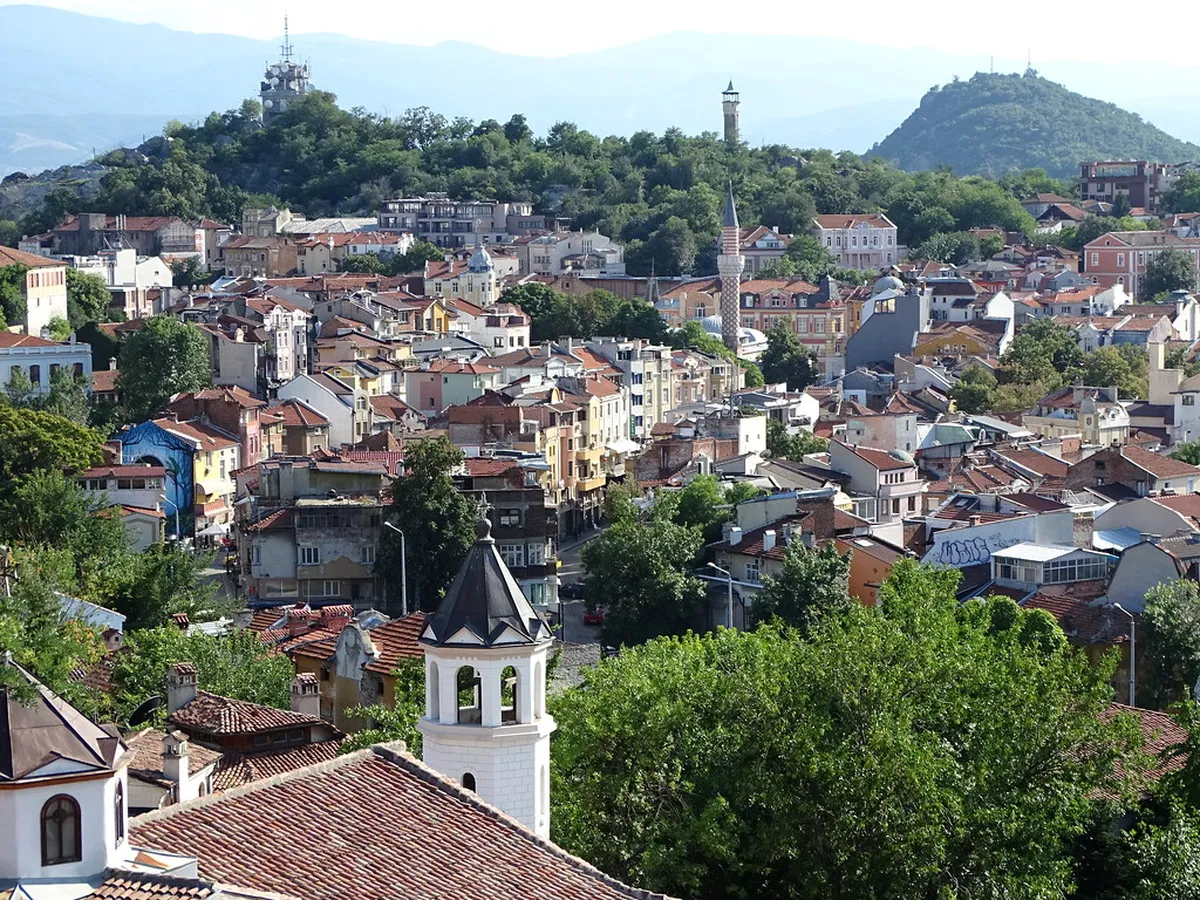
Face east from the upper paths and the historic core opens across the Three Hills. You can pick out the Old Town's Revival houses, church towers, and broken rooflines rising above the modern city. This is the view that makes Sahat Tepe useful before exploring the older districts on foot.
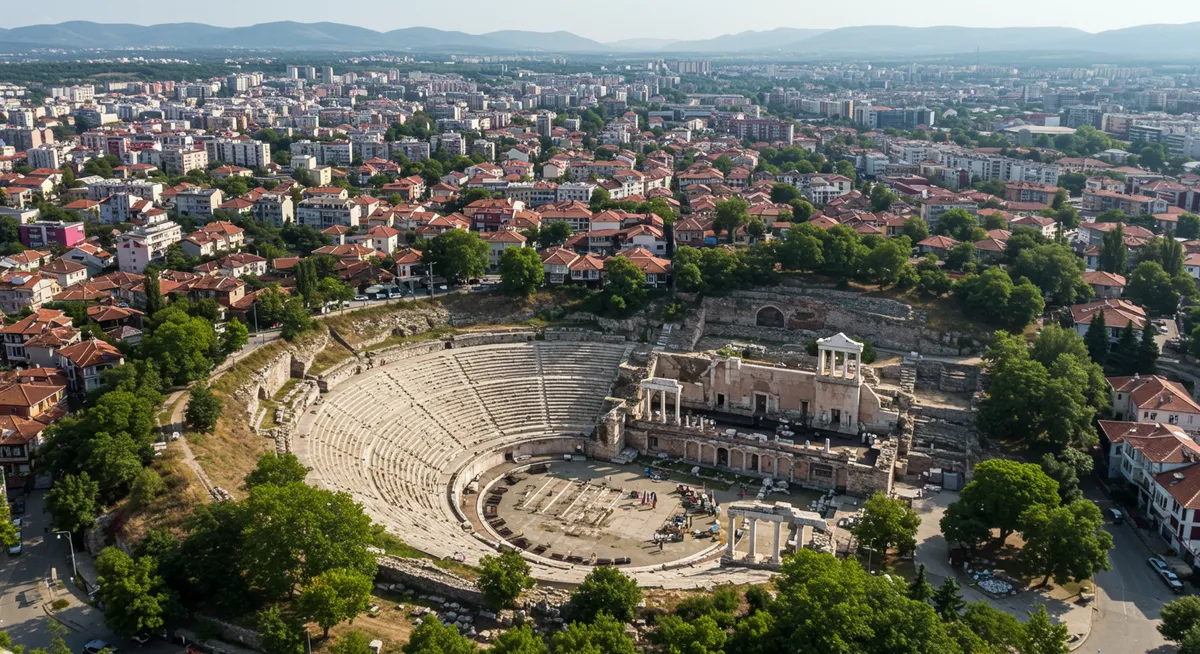
The Roman Theater of Philippopolis can be spotted from certain clear angles, especially when the pale seating catches the light. It is not always obvious at first glance, so use the line of the Old Town slope to orient your eye before searching for the theater.
Morning is best for this direction because the sun lights the facades instead of sitting behind them. If your priority is landmark identification rather than sunset color, arrive before the city haze builds. This eastward view also helps first-time visitors understand why Plovdiv's hills shaped the old settlement pattern.
Sightlines to Bunardzhika Hill and the Summer Theater
Turn west and Bunardzhika becomes the dominant landmark. The Alyosha Monument Visitor Guide is usually easy to identify on the ridge, and the green space between the hills gives this direction a softer feel than the dense Old Town view.
Below the western side of Sahat Tepe, look for the summer theater and the Orpheus summer cinema area. Local guides often point out that Sahat Tepe is one of the rare places where you can read Plovdiv's open-air cultural spaces from above. It is a useful angle if your itinerary includes concerts, cinema, or evening events.
South and southwest can reveal the Rhodope Mountains when the air is clear. In summer, the outline may fade in haze by midday, so late afternoon is usually better. In winter, the view can be sharper, but wind on the exposed rocks makes the stop feel colder than the street below.
The 16th-Century Clock Tower Mechanism
The clock tower is the older and more atmospheric landmark on Sahat Tepe. Sources connect the first clock tower here with the 16th century, while the stone structure visible today was rebuilt in the early 19th century after earlier damage.
Its mechanism adds the best piece of trivia on the hill. The clockwork was made in Vienna and brought to Plovdiv in 1883. According to the Free Plovdiv Tour, the heavy mechanism requires regular synchronization, and the hands are described as weighing around 100 kilograms.
Unlike many clock towers, this one is not about checking a dial. Its identity is tied to the bell and the sound of time carrying down the slopes. Stand near it for a few minutes before moving to the TV tower viewpoint; the contrast between stone, bell, and metal mast is the hill's main character.
Roman Heritage: The Temple of Venus Foundations
The least obvious story on Sahat Tepe is Roman. Objects found on the hill have led archaeologists to connect the site with a possible Temple of Venus. That belief adds depth to a place many visitors otherwise treat as a simple viewpoint.
Do not expect a fully reconstructed ruin like the city's better-known Roman monuments. The remains are subtle, and some stones blend into the natural rock and later landscaping. The value is in understanding that the summit was meaningful long before broadcasting equipment or the current clock tower appeared.
This Roman layer also fits the view toward the Old Town and theater. If you are building a day around ancient Philippopolis, pair this stop with the Roman Theater rather than treating the hill as a separate detour. The short walk between eras is one of Plovdiv's best qualities.
Best Walking Routes from Plovdiv Main Street
The easiest approach starts from the Main Street near Dzhumaya Mosque Visitor Guide. Turn west into the smaller streets and climb toward the green slope behind the Hristo G. Danov area. From the pedestrian zone to the upper viewpoints, allow 10 to 15 minutes at an unhurried pace.
A second useful approach begins near the galleries and stairways below the hill. This route feels more direct but can be steeper in short sections. If you are linking several central sights, fold Sahat Tepe into a 10 Best Ways to Experience a Plovdiv Walking Tour route instead of making it a separate trip.
Accessibility is the detail many short guides skip. The lower paths are manageable for most walkers, but the best photo rocks near the top are uneven, polished in places, and awkward after rain. Strollers, rolling luggage, and low-mobility travelers should stay on the wider paved paths and skip the exposed rock edges.
Photography Tips for Golden Hour on the Hill
For the most reliable golden-hour shot, arrive 45 to 60 minutes before sunset. Start near the clock tower, then move toward the southern and western rocks as the light lowers. This gives you time to test whether the tower looks better as a close subject or as part of a wider skyline.
A simple photo map works well here. Use the east side for the Three Hills and Old Town, the west side for Bunardzhika and sunset, and the south-facing rocks when you want the TV tower, city lights, and possible Rhodope outline in one frame. The Lost in Plovdiv photo walk notes the same strength: Sahat Tepe is close to Main Street but still outside the busiest tourist stream.
Phone photographers should tap exposure on the sky before sunset and on the tower after sunset. With a camera, a 24-35 mm equivalent lens is the most flexible range for combining the mast with city context. If you bring a tripod, keep it off narrow paths where people are descending in low light.
Seasonal Considerations for Visiting Danov Hill
Spring is the easiest season for most visitors. April and May bring greener slopes, comfortable temperatures, and clearer walking conditions. It is also a good time for daytime photography because the hill still feels fresh rather than dusty.
Summer requires more care. Plovdiv can be very hot, and exposed rock holds heat through the afternoon. In July and August, treat the TV tower view as an early morning or late evening stop, then return to shaded streets and cafes.
Autumn is the strongest all-round season for color and visibility. Winter can be beautiful after snow, but fog and slick stone are real issues. In 2026, the advice is unchanged: check the forecast, avoid wet rock edges, and bring an extra layer if you plan to wait through blue hour.
Essential Practical Tips for Your Visit
Sahat Tepe is a free public hill, so there is no ticket office, entry gate, or fixed visiting slot. The practical limit is comfort: daylight, weather, footwear, and how confident you feel on uneven stone. For most travelers, the hill works best as a 30 to 60 minute stop before dinner or after an Old Town walk.
There are no dependable facilities at the summit. Buy water before climbing, use toilets in the center, and do not count on parking near the base. The hill is central enough that walking is usually easier than driving.
- Wear sneakers with grip, especially if you plan to step onto the rocks for photos.
- Bring a small bottle of water in warm months; the climb is short but exposed near the top.
- Keep children away from unrailed edges and polished stone after rain.
- Use the hill as a low-effort add-on to Best Things to Do in Plovdiv around Main Street and the Old Town.
- Stay a few minutes after sunset if the sky is clear; the blue-hour city lights often improve the TV tower composition.
For related Plovdiv reading, see our Plovdiv Roman Stadium: A Complete Visitor Guide guide.
Continue planning: Use Best Things to Do in Plovdiv to connect this guide with the rest of your Bulgaria itinerary.
Frequently Asked Questions
Where is the best view of the Plovdiv TV Tower?
The best view of the Plovdiv TV Tower is from the southern rocks of Sahat Tepe. This spot allows you to see the full height of the tower against the city skyline. It is a favorite location for photographers during the sunset hours.
Can you go inside the Plovdiv TV Tower?
No, you cannot go inside the Plovdiv TV Tower as it is a working telecommunications facility. The tower is not open to the public for tours or observation decks. However, the surrounding park offers excellent external views of the structure.
How do you get to Sahat Tepe from Plovdiv city center?
You can reach Sahat Tepe by walking up the stairs located behind the Dzhumaya Mosque or near the Art Gallery on the Main Street. The walk takes about 10-15 minutes. It is one of the most accessible Best Things to Do in Plovdiv.
What is the history of the Clock Tower on Sahat Tepe?
The Clock Tower has roots dating back to the 16th century, though the current stone building is from the early 1800s. It houses a manual Vienna-made mechanism from 1883. It is one of the oldest functioning clock towers in the Balkans.
Sahat Tepe is not the highest viewpoint in Plovdiv, but it is one of the most revealing. The Plovdiv TV tower view gives you a modern skyline marker, while the clock tower, Roman traces, and surrounding hills explain why this small summit carries so much local memory.
For a first visit, climb from Main Street, circle the upper paths, and give yourself enough time to compare the east, west, and south sightlines. With comfortable shoes and a little patience for the light, Clock Hill becomes more than a quick viewpoint; it becomes a compact map of Plovdiv's history.