
Best Neighborhoods in Sofia to Visit in 2026: What Each Area Is Famous For
Best neighborhoods in Sofia to visit in 2026: what each district is famous for, signature attractions, vibe, walk times to Serdika, metro lines, and the best time to explore each area.
On this page
Best Neighborhoods in Sofia to Visit in 2026: What Each Area Is Famous For
Sofia in 2026 is a city built in concentric rings — a Roman-Byzantine core, a 19th-century elegant belt, communist-era residential blocks, and forested foothill villages climbing Vitosha Mountain. Each ring has neighborhoods with their own signature sights, vibe, and reason to visit. This guide is for travelers asking which Sofia neighborhoods are worth a half-day on foot, not where to book a hotel — for accommodation see our companion Best Areas to Stay in Sofia guide.
Quick answer: The most rewarding Sofia neighborhoods to visit in 2026 are Sredets (the historic center) for Roman ruins and Alexander Nevsky Cathedral, Oborishte for elegant 19th-century mansions and embassy row, Lozenets for cafe culture and South Park, Boyana for the UNESCO Boyana Church and the National History Museum, and Knyazhevo for free hot mineral springs at the foot of Vitosha. All five are reachable from Serdika Metro Station within 30 minutes.
For broader planning, pair this with Things to Do in Sofia (the master pillar), Downtown Sofia Things to Do, Hidden Gems in Sofia, and Sofia Landmarks. If you only have one day, our Sofia 1-Day Itinerary threads three of these neighborhoods on foot.
Sofia Neighborhoods at a Glance (2026)
Use this table to shortlist which districts to visit. Walk times are measured from Serdika Metro Station, the city’s central transit hub at the intersection of Metro Lines M1 and M2.
| Neighborhood | Famous for | From Serdika | Best time to visit |
|---|---|---|---|
| Sredets (Center) | Roman ruins, Alexander Nevsky, Vitosha Blvd | 0–10 min walk | Year-round, mornings |
| Oborishte | Embassies, Doctor’s Garden, 19th-c villas | 15 min walk | Spring/autumn afternoons |
| Lozenets | Cafes, South Park, design shops | 20 min walk / Tram 6 | Late afternoon, weekends |
| Boyana | UNESCO church, National History Museum | 25 min by Bus 64 | Mid-morning, weekdays |
| Knyazhevo | Free public mineral baths, Vitosha trailheads | 30 min by Tram 5 | October–April mornings |
| Studentski Grad | Student nightlife, cheap eats | 15 min by Metro M1 | Thursday–Saturday nights |
| Iztok & Geo Milev | Mid-century mosaics, leafy boulevards | 10 min by Metro M1 | Spring blossoms, autumn |
| Mladost | Business Park, modern cafes, Druzhba Lake | 15 min by Metro M1 | Summer evenings |
| Simeonovo & Dragalevtsi | Vitosha lift, monastery, hiking | 25 min by Bus 64/66 | Saturday/Sunday mornings |
1. Sredets (Historic Center): Where Roman Sofia Surfaces
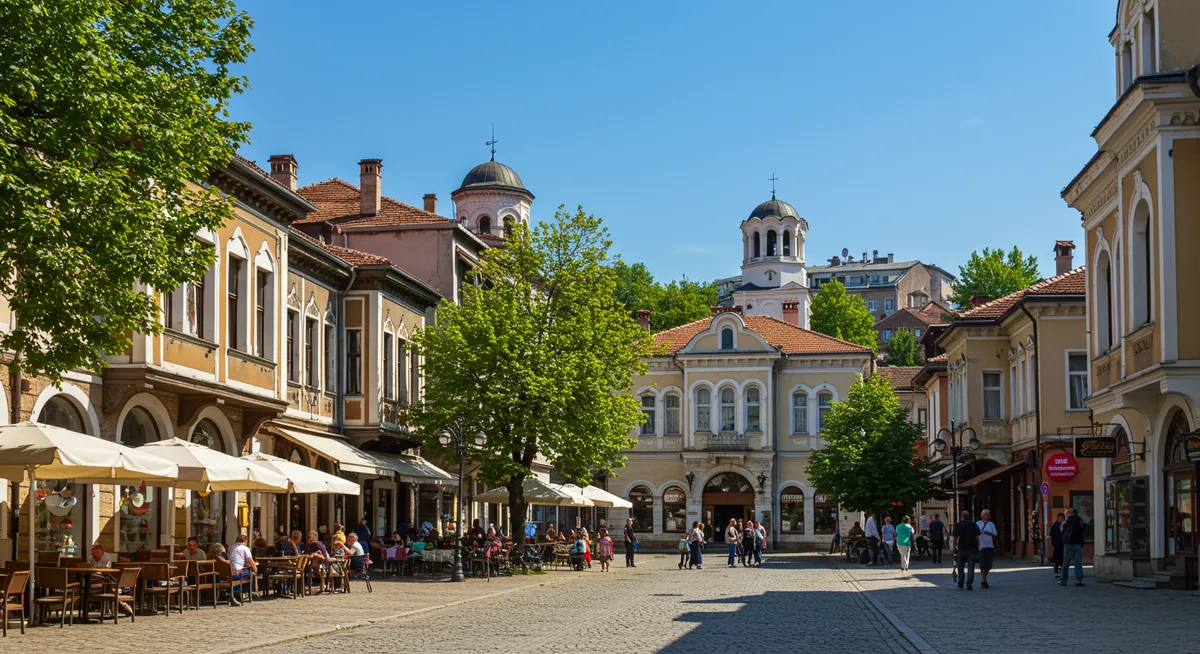
Sredets is the medieval and Roman heart of the city, and the single most-visited neighborhood in Sofia. Famous for the open-air Serdica Archaeological Complex (4th-century Roman streets exposed beneath the metro), the gold-domed Alexander Nevsky Cathedral, the 4th-century Rotunda of St. George, and the pedestrianized Vitosha Boulevard — Sredets concentrates roughly 80% of Sofia’s headline sights inside a 1.2 km walking radius. The vibe is European-capital polished by day, lively but well-lit by night. Get there: you are already there if you exit Serdika Metro (Line M1 or M2). Best time to visit is 9–11 a.m. on weekdays, before tour groups arrive at the cathedral. For the full walking sequence see Downtown Sofia Things to Do.
2. Oborishte: Embassy Row and 19th-Century Elegance
Just east of the cathedral, Oborishte is Sofia’s most architecturally elegant district — the diplomatic quarter, home to dozens of embassies, the Presidential residence on Doktor Hristo Stamboliyski, and the leafy Doctor’s Garden (Doktorska Gradina). The neighborhood’s 19th-century mansions, designed by Viennese-trained architects after the 1878 liberation, give it a Habsburg-meets-Balkan look you won’t see anywhere else in the country. The vibe is hushed, residential, and polished. Walk here in 15 minutes from Serdika via Tsar Osvoboditel Boulevard, or take Metro M1 to Sofiyski Universitet. Best in late April through May, when the lindens and chestnuts are in bloom. Photographers should arrive an hour before sunset.
3. Lozenets: Cafe Culture and South Park
Lozenets, draped along the slopes south of the center toward Vitosha, is where Sofia’s creative class spends its weekends. The neighborhood is famous for South Park (Yuzhen Park) — Sofia’s second-largest urban park at 91 hectares, with running paths, outdoor table tennis, and a Sunday flea market — and for the cluster of specialty coffee shops, design studios, and natural-wine bars along Bulgaria Boulevard and Krastyo Sarafov Street. The vibe is unhurried and local. Tram 6 from Sveta Nedelya runs the spine of the district in 10 minutes, or it’s a 20-minute walk from Serdika via NDK. Best on Saturday or Sunday afternoons when the park hits peak buzz. For more low-key spots, see Hidden Gems in Sofia.
4. Boyana: UNESCO Frescoes and Bulgaria’s Best Museum
Boyana is a former village absorbed by Sofia’s southern sprawl, set against the lower slopes of Vitosha Mountain. It is famous for two world-class sites within a 10-minute walk of each other: the Boyana Church, a UNESCO World Heritage site since 1979, whose 1259 frescoes are considered the finest pre-Renaissance painting in the Balkans (only 8 visitors admitted at a time, 10-minute slots, 10 BGN entry); and the National Museum of History, Bulgaria’s largest museum, holding the Panagyurishte and Valchitran gold treasures. The vibe is wooded and residential, with cobbled lanes climbing toward the mountain. Take Bus 64 from Hladilnika Metro (Line M2) or a direct taxi from the center for around 8 EUR. Best on weekday mornings — the church limits group entry, so weekends back up.
5. Knyazhevo: Free Hot Mineral Baths at the Foot of Vitosha
Knyazhevo is a leafy western foothill neighborhood that locals visit for one specific reason: the Knyazhevo Mineral Baths, free public taps where 31°C alkaline mineral water flows 24 hours a day from a source in use since Roman times. Bulgarians arrive with empty 5-liter bottles and a thermos; you can soak feet at the open basin. The neighborhood also marks the start of several Vitosha hiking trails, including the Bistrishko Branishte route to the Kopitoto TV tower viewpoint. Vibe: low-rise, village-like, with old stone houses and small bakeries. Tram 5 from the center reaches Knyazhevo terminus in 30 minutes. Best from October through April when the steam rising off the basins is most photogenic; pair with Day Hikes Near Sofia if you want to keep going up.
6. Studentski Grad: Where Sofia Goes Out
Sofia’s Studentski Grad (“Student Town”) is a purpose-built education district 4 km southeast of the center, with roughly 40,000 students from Sofia University, the Technical University, and UNWE living in compact dormitory blocks. By day it’s quiet; from Thursday through Saturday it’s the loudest nightlife district in Bulgaria, with dozens of bars, late-night gyros, and clubs along Akademik Boris Stefanov and 8-mi Decemvri Boulevards. Vibe: chaotic, cheap (a beer runs 3–4 BGN), young. Take Metro M1 to G. M. Dimitrov, then a 10-minute walk south. If you’re booking accommodation here for the prices, cross-reference our Best Areas to Stay in Sofia guide before committing — daytime amenities are thin.
7. Iztok and Geo Milev: Mid-Century Mosaics and Quiet Boulevards
Iztok (“East”) and the adjacent Geo Milev district are residential neighborhoods built in the 1960s–70s for the diplomatic and intellectual class. They are famous among architecture enthusiasts for the surviving socialist-modernist mosaics on apartment-block facades — particularly along Nikola Gabrovski Street and around the “Television Tower” (Telewizionnata Kula). Borisova Gradina, Sofia’s largest park (302 hectares), borders Iztok to the west and contains the Maria Luiza Lake, the Vasil Levski Stadium, and the Mausoleum of Knyaz Battenberg. Vibe: leafy, calm, very local. Metro M1 to Joliot Curie or G. M. Dimitrov drops you at the edge in 10 minutes from Serdika. Best in late April for chestnut blossoms or mid-October for autumn color.
8. Mladost: Modern Sofia and Druzhba Lake
Mladost is Sofia’s largest residential district, home to roughly 110,000 people across four numbered “Mladost 1–4” sub-neighborhoods. It’s where modern, post-1995 Sofia has happened — Sofia Tech Park, Business Park Sofia (the country’s biggest office complex), and the IKEA-anchored Mall Sofia sit here. Visitors come for two things: Druzhba Lake, a 720,000 m² reservoir converted into a swimming and sunbathing spot in summer, and the cluster of modern Bulgarian restaurants in Business Park’s ground-floor courtyards. Vibe: contemporary, concrete-and-glass, family-friendly. Metro M1 runs straight through (Mladost 1, 2, 3 stations). Best from June through early September; otherwise it’s mostly an office district.
9. Simeonovo and Dragalevtsi: Gateway to Vitosha
These twin foothill villages, now technically Sofia neighborhoods, are the launching pads for Vitosha Nature Park. Simeonovo is famous for the year-round Simeonovo gondola lift (when running — check status seasonally) that climbs to Aleko hut at 1,810 m, and Dragalevtsi for the 14th-century Dragalevtsi Monastery, hidden in beech forest 30 minutes’ walk above the village. The vibe is alpine: wood-fronted mehana taverns serving grilled meats, dogs trotting up forest trails, the smell of woodsmoke in winter. Bus 64 or 66 from Hladilnika Metro reaches both in 25 minutes. Best on Saturday or Sunday mornings before 10 a.m., when the trailhead parking still has space. Combine with Day Trips from Sofia for a full mountain day.
How to Choose Which Neighborhoods to Visit by Trip Length
If you have one day in Sofia, focus entirely on Sredets and walk into Oborishte for the second half — both are reachable on foot from Serdika and cover the essential history. With two to three days, add Boyana (half-day for the church and museum) and Lozenets (afternoon coffee plus South Park). On a five-day or longer trip, work in Knyazhevo for mineral water and a short Vitosha walk, plus Simeonovo or Dragalevtsi for a full mountain morning. Studentski Grad is night-only and best treated as an evening detour after dinner in the center. Mladost and Iztok are optional unless you have specific business or architectural interests.
Getting Between Sofia Neighborhoods in 2026
Sofia’s public transport is fast and cheap by European standards. Metro M1 and M2 intersect at Serdika and reach 35 stations across the city; a single ride costs 1.60 BGN (0.82 EUR after 1 January 2026 euro adoption). Trams 5, 6, and 22 link the center to Knyazhevo, Lozenets, and Iztok respectively. Buses 64 and 66 run from Hladilnika Metro into the Vitosha foothills (Boyana, Simeonovo, Dragalevtsi). A 24-hour multi-mode ticket costs 4 BGN. Taxis are inexpensive — budget around 7–10 EUR for a cross-city ride — but only use OK Supertrans, Yellow!, or eTaxi-app cars. For full transit details and ticket-machine instructions, see Transportation in Sofia.
Frequently Asked Questions
What is the most famous neighborhood in Sofia?
Sredets, the historic center, is Sofia’s most famous neighborhood. It contains Alexander Nevsky Cathedral, the Serdica Roman ruins exposed under Serdika Metro, the 4th-century Rotunda of St. George, the National Theater, and pedestrian Vitosha Boulevard. Roughly 80% of Sofia’s major sights sit within a 1.2 km walking radius of Serdika Metro Station.
Which Sofia neighborhood has the best views?
Boyana and Simeonovo, both at the foot of Vitosha Mountain, give the best views over Sofia. From the upper streets of Boyana you can see the city laid out below; from the Kopitoto TV tower above Knyazhevo (reached via the Bistrishko Branishte trail) the view extends 30 km on a clear day. For city-level vantage points see our Best Views in Sofia guide.
Is it safe to walk Sofia neighborhoods at night in 2026?
Yes — Sofia ranks among the safer European capitals. Sredets, Oborishte, Lozenets, and Iztok are all comfortable to walk after dark, well-lit and with steady foot traffic. Studentski Grad is busy with students until 3 a.m. Avoid the underpasses around Lions Bridge after midnight and the immediate streets behind the Central Railway Station. See Safety Tips for Tourists in Sofia for specifics.
How long does it take to walk from Sredets to Lozenets?
About 20 minutes (1.6 km) at a moderate pace from Serdika Metro through NDK Park to the upper edge of Lozenets at Krastyo Sarafov Street. Tram 6 covers the same route in roughly 10 minutes for 1.60 BGN.
Which Sofia neighborhood is best for foodies?
Lozenets and Oborishte for modern Bulgarian and natural-wine bars; Sredets for traditional mehana taverns; Mladost’s Business Park for international and chef-driven concepts. The Pirotska Street area near the Halite covered market in Sredets is the densest cluster of historic Bulgarian food halls.
Can I see Boyana Church without a tour?
Yes. Buy a 10 BGN ticket at the on-site visitor center; entry is in groups of 8 with a 10-minute time limit inside to protect the frescoes. The adjacent National Museum of History is a separate 10 BGN ticket and unlimited time. Bus 64 from Hladilnika Metro stops 5 minutes from the church.
Final Thoughts on Visiting Sofia’s Neighborhoods
Sofia rewards travelers who treat it as a city of distinct districts rather than a single tourist core. Spend a morning in Sredets for the Roman layer, an afternoon in Oborishte or Lozenets for the 19th-century and contemporary layers, and a half-day in Boyana or Knyazhevo for the village-and-mountain edge — you’ll come away with a much fuller picture than any guidebook list of “top sights” alone delivers. For more cluster reading, dive into Things to Do in Sofia, Hidden Gems in Sofia, and Best Areas to Stay in Sofia.