
Things to Do in Plovdiv in Winter (2026 Guide)
Best things to do in Plovdiv in winter 2026: Christmas markets, NYE Old Town, thermal springs, Pamporovo ski day trips & cozy restaurant picks. Plan your Dec-Feb visit.
On this page
Best Things To Do in Plovdiv in Winter (2026 Guide)
Planning a winter escape? Plovdiv is one of Eastern Europe's most underrated cold-weather destinations. In 2026, this 8,000-year-old city delivers a rare mix: snow-dusted Roman ruins, a buzzing Christmas market in Tsar Simeon Garden, New Year's Eve celebrations in a medieval Old Town, and same-day access to both thermal spring retreats and ski slopes. Temperatures in December–February hover between -2°C and 8°C — cold enough for atmosphere, mild enough for sightseeing. This guide covers everything worth doing, from cozy museum afternoons to full-day excursions into the Rhodope Mountains. For a complete overview of the city year-round, start with our main guide to things to do in Plovdiv.
1. Christmas Market in Tsar Simeon Garden
What is it? The Plovdiv Christmas Market occupies Tsar Simeon Garden — the city's grand 19th-century central park — from late November through early January 2026. Dozens of wooden chalets line the main allée, selling hand-painted ornaments, woollen goods, rose-oil cosmetics, and local food. Entry is free; the market opens daily 10:00–21:00.
Why go? This is Plovdiv's most photogenic winter event. The twinkling lights reflect off the garden's bare plane trees, and the air smells of hot glintwein (mulled wine) and roasted chestnuts. Unlike the enormous Sofia Christmas market, Plovdiv's version retains a neighbourhood feel — locals outnumber tourists on weekday evenings. For more festive winter events across Bulgaria, check Bulgaria's official tourism site.
Don't miss: Try banitsa s tikvichki (pumpkin pastry), koleda pitka (Christmas bread), and a mug of grozde glintwein made with local Thracian Valley wine. Artisan stalls near the fountain sell hand-knitted wool sweaters — a genuinely useful souvenir for the rest of your trip. For more festive ideas, our Plovdiv events guide lists seasonal concerts and performances.
Travel tip: Visit on a weekday evening (18:00–20:00) for the best light-to-crowd ratio. Weekends after 16:00 get packed.
2. New Year's Eve in the Old Town
What is it? Plovdiv's Old Town (Стария град) throws one of Bulgaria's liveliest New Year's Eve street parties. The cobblestone lanes between Dzhumaya Square and the Roman Theatre fill with revellers from around 22:00 on 31 December, with a midnight fireworks display visible from the hilltop terraces.
Why go? The backdrop alone makes this special: you're ringing in the new year surrounded by 18th-century Revival mansions with snow occasionally dusting the rooftops. Several Old Town mehanas (taverns) offer fixed NYE menus (typically 60–100 BGN per person including a welcome rakia shot and live folk music) — book at least two weeks in advance.
Don't miss: Stake out a spot on Sahat Tepe hill before midnight for an elevated view of the fireworks over the Old Town. Dress in serious layers: at midnight on 31 December temperatures routinely drop below -1°C. Check our Plovdiv nightlife guide for bar recommendations that host NYE events.
Insider tip: Book accommodation inside or right next to the Old Town for NYE — taxis become scarce after midnight.
3. Explore the Ancient Roman Theatre
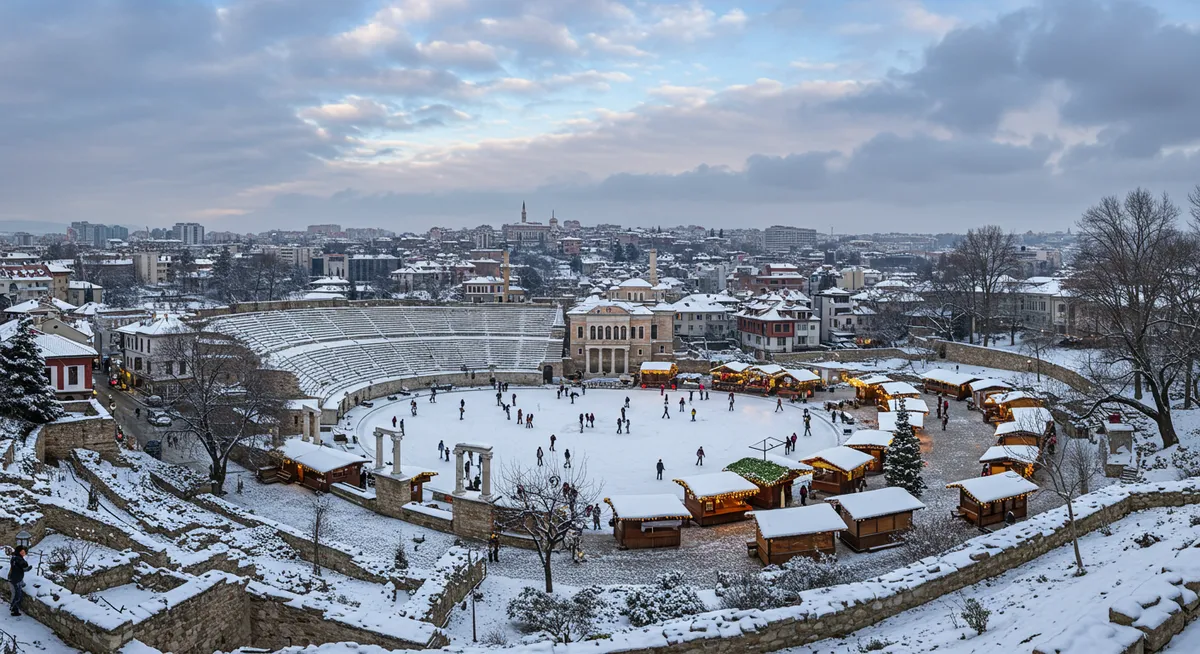
What is it? The Ancient Roman Theatre is an extraordinarily well-preserved 2nd-century AD amphitheatre carved into one of Plovdiv's three hills. During winter, the stone seating is often dusted with snow and the surrounding city shimmers in low winter light — arguably more dramatic than in summer.
Why go? The theatre is open year-round. In winter, visitor numbers drop sharply, giving you a near-private experience. The views over the terracotta rooftops and the Rhodope Mountains are exceptional on clear days. This 2nd-century masterpiece is one of Plovdiv's most significant historical landmarks. For full context, our dedicated Plovdiv Roman Theatre guide covers history, tickets, and the best photo angles.
Don't miss: Walk to the topmost row for the panoramic sweep across Plovdiv towards the Rhodope Mountains. Occasional winter concerts and events are staged here — check the city events calendar before you visit.
Practical note: Admission is 5 BGN (2.50 EUR). Open daily 09:00–17:30 in winter (2026). Wear gloves — the stone seating is genuinely cold.
4. Wander Through Plovdiv Old Town
What is it? The Old Town (Kapana-adjacent historical quarter) is a labyrinth of steep cobblestone lanes flanked by colourful Bulgarian National Revival houses from the 18th and 19th centuries. In winter, foot traffic drops to almost nothing on weekday mornings — you can walk entire streets without meeting another tourist.
Why go? Snow transforms the Old Town into a scene that looks lifted from a period film. The Balabanov House, Hindliyan House, and Nedkovich House are all worth ducking inside: they're heated and showcase period furnishings. For a self-guided walk with detailed context, see our Plovdiv Old Town guide.
Don't miss: The viewpoint terrace above the Old Town faces south — on clear winter afternoons, the Rhodope peaks are snowcapped and visible in full. Wear boots with grip: the cobblestones ice up overnight and aren't always gritted before 09:00.
Insider tip: Most Revival house museums charge 4–6 BGN entry and close at 17:00 in winter. Combine two or three in a single morning before lunch in Kapana.
5. Thermal Spring Day Trip: Hisarya or Banya
What is it? Two spa towns sit within easy reach of Plovdiv. Hisarya (40 km north; 45 min by car or bus) is a purpose-built Roman-era spa resort with multiple public mineral baths still in operation. Banya village (50 km south, near Karlovo) has smaller, quieter thermal facilities popular with locals. Both operate year-round.
Why go? Soaking in 38–41°C mineral water while snow falls is one of the quintessential Bulgarian winter experiences. Hisarya's public bath entry starts at 8–12 BGN (4–6 EUR) in 2026. The town also retains sections of Roman walls and a small archaeological museum, making it a complete half-day outing rather than just a spa stop.
Don't miss: The Augusta spa complex in Hisarya is the most popular with international visitors and offers private mineral pool hire (approximately 40 BGN/hour). For a day out that combines thermal springs with monastery culture, combine Hisarya with Bachkovo Monastery on the same loop. More excursion ideas are in our day trips from Plovdiv guide.
Practical note: Regular buses from Plovdiv Central Bus Station to Hisarya run every 1–2 hours; return fare is approximately 10 BGN. Journey time 50 min.
6. Ski Day Trip to Pamporovo
What is it? Pamporovo is Bulgaria's southernmost ski resort, set in the Rhodope Mountains 85 km south of Plovdiv (1.5–2 hour drive). At 1,650 m elevation, it typically has reliable snow cover from December through March. The resort suits beginners and intermediate skiers; it has 23 km of groomed pistes, 11 lifts, and a ski school.
Why go? It's the easiest ski day trip from any major Bulgarian city — no mountain pass crossing required. Pamporovo ski resort offers reliable snow from December through March with 23 km of groomed pistes. A day lift pass costs 60–70 BGN (30–35 EUR) in 2026. Ski and boot rental is available on-site for roughly 40 BGN/day. Even non-skiers enjoy the snow scenery and the resort's mehanas for lunch.
Don't miss: The run from Snezhanka Peak offers the longest vertical descent and the best Rhodope Mountain views. If you're travelling with children, the ski school's half-day group lessons (approximately 50 BGN per child in 2026) are well-regarded. Check our day trips from Plovdiv page for transport options including private transfers.
Getting there: Buses depart Plovdiv Central Bus Station to Pamporovo via Smolyan; return fare approximately 20 BGN. First bus around 07:30; last return around 17:00. Check current schedules at the bus station.
7. Museum Season: Indoor Culture in the Cold
What is it? Winter is peak season for Plovdiv's indoor cultural venues. The Regional Ethnographic Museum (Kuyumdzhioglu House), the Historical Museum, the Archaeological Museum near Dzhumaya, and the National Revival Church complex all keep full winter hours and are warm, unhurried places to spend a few hours.
Why go? Crowds are minimal between November and February. The Ethnographic Museum's collection of 19th-century Bulgarian national costumes — elaborate embroidered textiles representing different regional traditions — is genuinely world-class and rarely takes more than 2 hours. Admission is typically 5–6 BGN per venue.
Don't miss: The Archaeological Museum holds the Panagyurishte Gold Treasure (the original is in Sofia, but a high-quality replica is here) and an impressive Thracian sword collection. For context on the city's layered history, combine this with a visit to the Roman Theatre on the same afternoon.
Expert tip: A combined ticket covering four major Plovdiv museums is available for 15 BGN at the Historical Museum on Saedinenie Square — excellent value if you plan to spend a full rainy or snowy day indoors.
8. Thracian Valley Wine Tastings
What is it? The Thracian Valley wine region — centred on the lowlands between Plovdiv and the Rhodope Mountains — is Bulgaria's most productive wine-growing area, home to wineries producing Mavrud, Rubin, and Merlot varietals. Several wineries within 30–60 km of Plovdiv offer year-round cellar tours and tastings.
Why go? Winter is one of the best times to visit wineries — harvests are long over, the cellar staff have more time for in-depth tours, and tasting rooms are peaceful. A guided tasting at Katarzyna Estate or Minkov Brothers typically runs 25–45 BGN per person (2026) and includes 5–6 wines plus local charcuterie. These make for a warm, convivial half-day outing when the weather turns grey.
Don't miss: Ask specifically for aged Mavrud — the Thracian Valley's signature red grape, with deep tannic structure and notes of dried fruit that hold up particularly well in winter. Pair with kashkaval (aged Bulgarian cheese) and lyutenitsa (roasted pepper-and-tomato relish).
Practical note: Most wineries require advance booking for cellar tours (call or email directly); some are 45–60 min drive from Plovdiv, making a hire car or private transfer worth it for a group.
9. Discover the Kapana Creative Quarter
What is it? Kapana — literally "The Trap" — is Plovdiv's bohemian creative district, a compact grid of repurposed artisan workshops now occupied by independent coffee shops, craft beer bars, galleries, and concept stores. In winter, Kapana's interiors (exposed brick, wood-burning stoves, dense playlists) make it the city's best cold-weather hangout.
Why go? Kapana is where Plovdiv's young creative community congregates. You'll find specialty coffee roasters, natural wine bars, and pop-up exhibitions running throughout winter. The district is traffic-free, which means even on a snowy afternoon you can wander between venues without the usual urban hazards. For a deeper look, see our Kapana Plovdiv guide.
Don't miss: Friday evenings see Kapana at its most lively year-round. In December, several venues run advent events: craft markets, live acoustic sessions, and themed tasting nights. Wool sweater shops along ul. Avksentiy Veleshki are great for buying warm layers mid-trip.
Insider tip: Grab a coffee at one of the roasters on ul. Kuklensko Shose and ask staff for current pop-up event tips — Kapana's programme changes weekly.
10. Asen's Fortress & Bachkovo Monastery Day Loop
What is it? Both sites sit in the Rhodope foothills south of Plovdiv and combine naturally into a single day trip (approximately 45–60 km from the city centre). Asen's Fortress is a 12th-century medieval stronghold perched on a river gorge cliff; Bachkovo Monastery — one of Eastern Europe's largest Orthodox monasteries — sits 10 km further into the mountains.
Why go? The Asenitsa River gorge around the fortress fills with mist on winter mornings, creating atmospheric photography conditions unlike anything in summer. Bachkovo's courtyard frescoes and the monastery's museum of medieval icons are particularly well-lit on overcast winter days when harsh midday shadows disappear. The gorge footpath can be icy in January — wear boots with ankle support.
Don't miss: The Church of the Holy Mother of God inside Bachkovo has original 17th-century frescoes covering every interior surface. Combine this loop with the full day trips guide to plan transport and timings.
Practical note: A taxi or hire car is the most practical option for this loop (approximately 100–130 BGN for a return taxi from central Plovdiv). Public buses serve Bachkovo; Asen's Fortress requires a short walk or taxi from the village of Asenovgrad.
11. Cold-Weather Restaurant Picks in Plovdiv
What is it? Winter is when Plovdiv's restaurant scene is at its most compelling. The city has a strong tradition of mehanas — traditional Bulgarian taverns with open fireplaces, low wooden tables, and menus built around slow-cooked dishes. Several Old Town and Kapana restaurants also push seasonal menus from October through February.
Why go? Bulgarian winter cooking is excellent: kavarma (clay-pot pork or chicken stew with peppers and mushrooms), bob chorba (smoky bean soup), sarmi (stuffed vine or cabbage leaves), and shkembe chorba (tripe soup, the traditional morning-after remedy). Prices remain very reasonable by Western European standards — a full mehana dinner with wine typically runs 25–40 BGN per person in 2026.
Don't miss: Look for restaurants listing Thracian Valley wines by the carafe rather than only by the bottle — good-value houses pour local Mavrud and Merlot blends for 8–12 BGN per 500 ml. For a full restaurant rundown, our Plovdiv food & drinks guide covers the best venues by neighbourhood and budget.
Expert tip: Old Town mehanas are typically more atmospheric; Kapana cafes and wine bars are trendier and more suited to lighter evening meals. Both are worth a visit on different nights.
12. Nebet Tepe: Winter Sunrise Over Plovdiv
What is it? Nebet Tepe is the highest of Plovdiv's original founding hills (Trimontium), offering 360-degree views across the city, the Thracian Plain, and on clear winter days, the Rhodope Mountains to the south. The summit is free to access at any hour.
Why go? Winter sunrises here — typically 07:30–08:00 in December — paint the terracotta rooftops amber. With snow on the ground and fog lingering in the valley, the view is extraordinary. The ruins of ancient Thracian and Roman fortifications add historical texture. For more vantage-point ideas, see our best views in Plovdiv guide.
Don't miss: The path to Nebet Tepe from the Old Town side ices overnight in winter — approach from the wider paved lane on the east side of the hill rather than the steep cobblestone shortcut. Sunrise timing varies; check sunrise tables for your exact dates.
Insider tip: Combine with a Kapana breakfast immediately afterwards — walk down the hill, 10 minutes to the creative quarter, and reward yourself with a flat white and a banitsa.
Frequently Asked Questions
What is the weather like in Plovdiv in winter?
Plovdiv winters run December through February with average highs of 4–8°C and lows between -2°C and 2°C. Light snowfall is common in January and February; heavy snow is unusual but possible. Pack a warm coat, waterproof boots with grip (Old Town cobblestones ice over), gloves, and layers. Rain is more common than snow in December. Overall, the cold is very manageable for active sightseeing — dress warmly and you'll be comfortable all day.
When is the Plovdiv Christmas market in 2026?
The Plovdiv Christmas Market in Tsar Simeon Garden typically runs from late November through early January. Opening hours are approximately 10:00–21:00 daily. Entry is free. The market features handmade crafts, local food stalls, mulled wine, and occasional live performances. Evening visits (18:00–20:00) offer the best atmosphere when the lights are on and the crowds are manageable.
Can you do a ski day trip from Plovdiv?
Yes. Pamporovo ski resort is 85 km south (1.5–2 hour drive). A 2026 day lift pass costs around 60–70 BGN (30–35 EUR). Ski rental is available on-site for around 40 BGN/day. Buses run from Plovdiv Central Bus Station; a return bus ticket is roughly 20 BGN. The resort suits beginners and intermediates and typically has snow from mid-December through early March.
Are thermal springs near Plovdiv worth a visit in winter?
Absolutely. Hisarya (40 km north) has mineral pools at 38–41°C open year-round. Public bath entry starts at 8–12 BGN. Winter is the best season — soaking in hot mineral water while it snows is a genuine highlight. Banya village (near Karlovo) is a quieter alternative. Both are reachable by bus from Plovdiv in under an hour.
What do restaurants in Plovdiv serve in winter?
Winter menus feature hearty Bulgarian comfort food: kavarma (clay-pot stew), bob chorba (bean soup), sarmi (stuffed cabbage), and shkembe chorba. Pair with a Thracian Valley Mavrud. Mehanas typically charge 25–40 BGN per person for a full dinner including wine in 2026. The Old Town and Kapana have the highest concentration of quality restaurants.
Plovdiv in winter rewards those who come prepared for the cold. Whether you're counting down to midnight in the Old Town, skiing the Rhodope slopes at Pamporovo, soaking in Hisarya's thermal springs, or simply working your way through the Kapana coffee shops on a grey afternoon, the city delivers far more than most winter visitors expect. Use our main things to do in Plovdiv guide for year-round planning, and the Plovdiv 1-day itinerary if you only have a short visit. For a broader trip, the 3-day Plovdiv itinerary gives you time to tick off the thermal springs, a winery, and the best museum cluster in a single trip.