
Plovdiv at Night: Top Things to Do (2026 Guide)
Best things to do in Plovdiv at night in 2026: Singing Fountains, illuminated Old Town walk, Opera Open 2026 at the Roman Theatre, Kapana bars, live music & late-night transport guide.
On this page
Best Things To Do in Plovdiv at Night (2026 Guide)
Plovdiv, one of Europe's oldest continuously inhabited cities, transforms into a magical destination as the sun sets. In 2026, the city's evening scene blends ancient history with modern energy — illuminated Roman ruins, Kapana's ambient bar terraces, free fountain shows, and al-fresco dining on cobblestone streets. Whether you're after romantic twilight strolls, cultural performances, or simply a great meal under the stars, this guide covers every worthwhile after-dark activity in the city. Explore more in our complete things to do in Plovdiv guide, or see our curated romantic things to do in Plovdiv for couples planning a special evening. For the full bar and club scene, our Plovdiv nightlife guide goes deeper, and for a day-by-day framework see the Plovdiv walking tour guide.
1. Watch the Singing Fountains Show in the Central Garden
What is it? The Singing Fountains (Peeyushchi Fontani) sit in the heart of Plovdiv's Central Garden, a leafy park just below the Old Town hills. The show synchronises multiple water jets with coloured LED lighting and a rotating music programme — classical pieces on weekdays, popular Bulgarian and international pop on weekends. Admission is completely free, making this one of the best free evening stops in the city.
Why go? The 30-minute show draws an appreciative crowd of families, couples, and solo travellers every evening. The garden itself is pleasantly cool at night after hot summer days, and the surrounding benches and café kiosks let you linger before or after the performance. Locals consider the fountain area the city's informal evening living room — a great spot to people-watch and soak in the relaxed Bulgarian pace of life.
Practical info (2026): Shows run nightly from approximately 21:00 to 22:30, with an extra late showing at 22:30 on Fridays and Saturdays (June–September). Outside peak season (October–May) the schedule shifts to 20:00. Admission: free. Getting there: 5-minute walk south from the main pedestrian street, ul. Knyaz Alexander I. Allow 45 minutes including pre-show strolling.
Insider tip: Arrive 10 minutes early to claim a front-row bench — latecomers often watch from a standing position behind the crowd. The fountain looks best from the north side, where the lights reflect in the shallow pool.
2. Opera Open 2026 at the Ancient Roman Theatre
What is it? The Ancient Roman Theatre of Philippopolis — built in the 1st century AD under Emperor Trajan — is Plovdiv's most spectacular open-air venue. In 2026, the annual Opera Open festival runs 23 June–9 September with an ambitious 14-production programme: from Verdi's Nabucco (4 July) and Aida (25 July), to Queen's rock-symphonic A Night at the Opera (24 August), Carmen (28 August), and Swan Lake (4 September). Most performances start at 21:00 (full programme at operaplovdiv.bg). The theatre seats approximately 2,200 and is fully lit by the time the curtain rises.
Why go? Seeing the 2,000-year-old marble tiers illuminated against the night sky — with the Rhodope Mountains silhouetted beyond — is one of the most dramatic live-entertainment experiences in the Balkans. Even without a ticket, the exterior viewing platforms above the theatre are lit until 23:00 and free to approach. For the complete Old Town evening walk that passes here, see our Plovdiv Old Town guide.
Practical info (2026): Tickets 15–60 BGN (8–30 EUR) depending on artist and seat tier. Book online via operaplovdiv.bg or the Plovdiv Opera box office (open daily 10:00–18:00). Popular productions — Nabucco, Swan Lake, Carmen — sell out 2–3 weeks ahead. Guided night tours of the Old Town that pass the theatre depart from Dzhumaya Square at 20:00 daily (10 BGN / 5 EUR).
Insider tip: Book summer concert tickets at least two weeks in advance — popular classical evenings sell out fast, especially in July and August.
3. Illuminated Old Town Walking Route After Dark
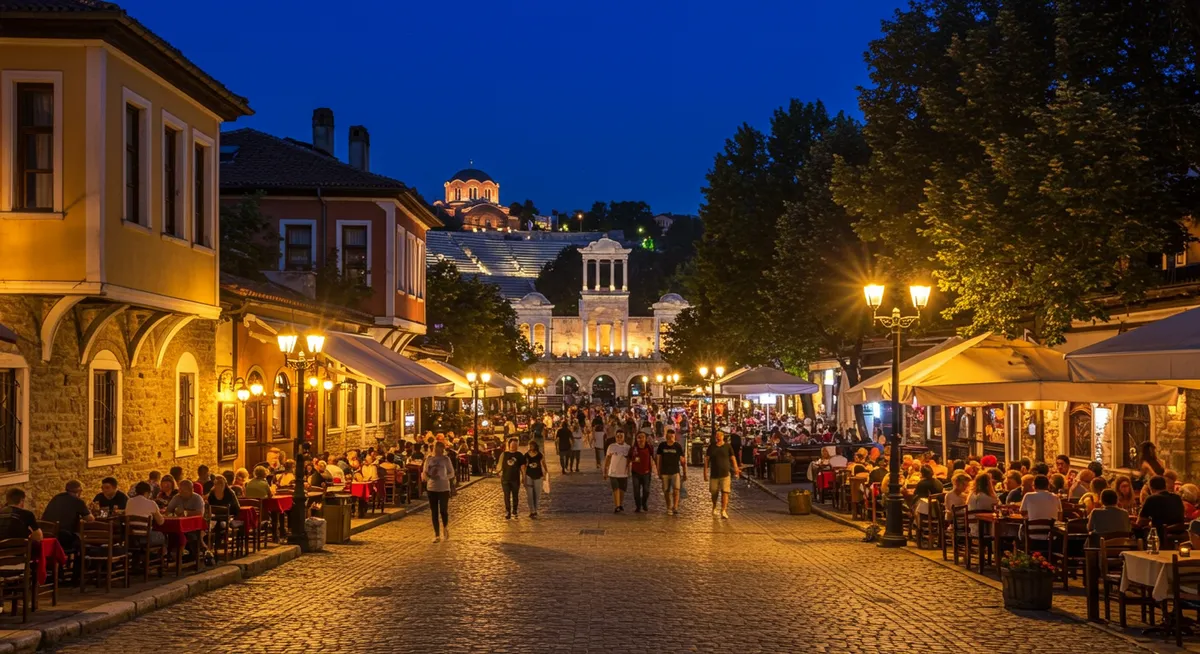
What is it? After sunset, the Old Town (Stariat Grad) undergoes a complete transformation. The municipal floodlighting scheme — upgraded ahead of Plovdiv's 2019 European Capital of Culture year — keeps the Bulgarian National Revival mansions, ancient Roman walls, and cobblestone lanes lit until at least midnight. With the souvenir stalls closed and tour groups gone, the neighbourhood quiets to an intimate hum of diners and strolling couples.
The recommended route (90 minutes):
- Start at Dzhumaya Mosque (20:00) — the Ottoman landmark glows warmly against the evening sky; the adjacent Roman Stadium ruins are lit from below.
- Ascend ul. Knyaz Tseretelev — the steepest cobblestone lane in the Old Town; lanterns cast sharp shadows on the Revival-period house facades.
- Saborna Street — the showpiece row of 19th-century mansions, all floodlit. Look up for the decorative overhanging oriels at their most photogenic in artificial light.
- Nebet Tepe summit (21:00) — the highest of the three Old Town hills offers a 270° panorama of city lights, Maritsa valley, and the distant Rhodopes. Ancient citadel walls are illuminated; the platform is free and always open.
- Descend through Kapana — exit the Old Town from the west side and drop into the creative district for a nightcap, connecting naturally with the activity below.
Wear flat, comfortable shoes: original cobblestones are beautiful but uneven. The route is safe throughout; the lanes are not completely deserted even at 22:00 in summer. See our Plovdiv walking tour guide for a printable map version.
Insider tip: Night is widely considered the most photogenic time to visit the Old Town — bring a tripod or use your phone's night mode for the long exposures the lit facades reward.
4. Catch Sunset from the Best Viewpoints in Plovdiv
What is it? Plovdiv's unique multi-hill topography means several excellent hilltop terraces face west for sunset views. The city's seven hills each offer a slightly different perspective — from the ancient citadel ruins of Nebet Tepe to the post-Soviet Alyosha monument on Bunardjika Hill. Sunset falls between 19:30 (November) and 21:10 (June) in Plovdiv, with views extending to the Rhodope Mountains.
Why go? Watching the sun drop behind the Rhodope Mountains from a rooftop terrace or hilltop garden is one of the classic Plovdiv evening rituals. The warm-golden light on the Old Town's red-tiled rooftops during the golden hour is exceptional, and the transition from dusk to night — when city lights gradually illuminate the Maritsa valley — is a slow, satisfying spectacle. Our dedicated best views in Plovdiv guide covers all the top vantage points with walking directions.
Top sunset spots (2026):
- Nebet Tepe — Free, always open, ancient walls as foreground, panoramic 270° view. Best reached via ul. Tsar Simeon I from the Old Town.
- Dzhendem Tepe (Youth Hill) — Open park, benches, romantic atmosphere. Free. A 10-minute walk from the main pedestrian street.
- Bunardjika Hill — Overlooked by the Alyosha Soviet monument; dramatic scale, 360° view. Free, accessible by taxi or a steep 20-minute uphill walk.
- Rooftop terraces in Kapana — Several bar/café rooftops open from 17:00; no cover charge, drink minimums only (cocktails ~12–15 BGN / 6–8 EUR, 2026).
5. Explore the Kapana Creative District After Dark
What is it? Kapana — meaning "the trap" in Bulgarian, referencing its maze-like lanes — is Plovdiv's bohemian creative quarter. During the day it's a hub for artisan shops and galleries; from 20:00 onwards it shifts into bar and live-music mode. Ambient terraces spill onto the cobblestones, local craft-beer taps flow, and the background noise shifts from children to jazz and indie guitar.
Why go? Kapana strikes the right balance between lively and civilised — it's not a club strip, but rather a neighbourhood where you can move from a quiet cocktail bar to a loud live-music courtyard to a late-night meze spot within a two-minute walk. The district is pedestrianised, safe to wander alone or in groups, and tends to close around 01:00–02:00 on weeknights. Our Kapana guide has the full neighbourhood breakdown; for the heavier nightlife scene see the Plovdiv nightlife guide.
Don't miss: Bar Craft Kapana for Bulgarian microbrewery taps (Sofia, Plovdiv, and Burgas labels); spontaneous street-art installations; and acoustic musicians who set up in the wider courtyard spaces on summer evenings. Check Plovdiv events listings for pop-up markets and open-air screenings that regularly use Kapana as their venue.
Travel Tip: Kapana is compact enough that getting lost is part of the fun — but if you need an anchor, start at pl. Makedoniya (the small square at the northern entrance) and explore outward from there.
6. Live Music and Theatre After 10pm in Plovdiv 2026
Where to go for late-night live music: Plovdiv has a genuinely strong live-music culture that stays active well past 22:00 on weekends. These are the most reliable after-dark venues in 2026:
- Bee Bop Café — Plovdiv's best-known jazz and blues venue; sets run 21:00–midnight most nights, with rock and funk on weekends. Cover 5–10 BGN (2.50–5 EUR) on busy nights. Small room — every seat feels close to the stage. Arrive 30 minutes early on Fridays. Check their Facebook page for the weekly programme.
- VOID — Larger venue known for brilliant sound engineering and a diverse programme: live bands, DJs, and occasional theatre nights. Two bars, late licence. Typically open until 02:00–03:00 on weekends. Cover varies by event (0–15 BGN).
- Fargo Bar — Fancy cocktail bar with funky DJ parties on Fridays and Saturdays drawing a young crowd. Cocktails 12–16 BGN (6–8 EUR). Gets busy after 22:30; arrive earlier for a table.
- Plovdiv State Opera (indoor season) — The Plovdiv State Opera indoor season runs September–June. Tickets 20–45 BGN (10–23 EUR, 2026), significantly cheaper than Western European equivalents. Smart-casual dress; box office opens 10:00 daily.
For one-off festivals, the International Folklore Festival (August) and Plovdiv Jazz Festival (October) bring additional late-night programming to outdoor stages across the city. Book accommodation early for these weekends — the city fills up fast. See Plovdiv events for confirmed 2026 dates.
Insider tip: Tuesday and Thursday sessions at Bee Bop are the least crowded and often feature the most experimental, locally-produced music.
7. Have a Drink at Fabric Bar
What is it? Fabric Bar is one of Plovdiv's busier cocktail bars, occupying a stylish industrial-chic space that works equally well at 19:00 (early sundowners) or midnight. The menu runs to 40+ cocktails, craft beers on tap, and a solid wine list from Bulgarian and international producers. Cocktails average 12–16 BGN (6–8 EUR, 2026).
Why go? Fabric Bar works as both a starting point and a late-night option. The staff are knowledgeable and pour generously; the playlist stays at conversation-friendly volume until about 22:30, then shifts to louder sets. Its central location folds easily into an Old Town walk or a post-dinner wander from Kapana.
Don't miss: The signature Bulgarian-spirit cocktails using local rakia as the base spirit. Check their Instagram for weekly guest-bartender nights and seasonal menu launches. Arrive early on weekends; the bar fills up by 21:30 in peak season.
Insider tip: The covered side terrace is quieter than the main bar area and a better spot for longer conversations over drinks.
8. Dine at a Traditional Bulgarian Restaurant
What is it? Plovdiv has a strong tradition of mehana-style restaurants — cosy, candlelit venues serving regional Bulgarian food with occasional live folk-music sets. The Old Town and the streets around Kapana both have a good concentration. Dinner for two with wine typically runs 40–70 BGN (20–35 EUR, 2026).
Why go? Dining at a traditional Bulgarian restaurant is a genuinely immersive cultural experience. Beyond the food itself — expect Shopska salad, slow-braised kavarma, grilled kebapche, and home-made banitsa — the atmosphere is convivial and unhurried. Many mehani keep their kitchens open until 23:00, making them ideal for a late dinner after a sunset walk or a fountain show. For a deeper look at Plovdiv's culinary scene, our Plovdiv food & drinks guide covers the best restaurant picks by neighbourhood, while best restaurants in Plovdiv lists the top-rated venues with current prices.
Don't miss: Shopska salad (tomatoes, cucumber, peppers, and grated white sirene cheese — Bulgaria's national starter); kavarma (slow-cooked pork or chicken in a clay pot); and Bulgarian Mavrud red wine from the Thracian Valley just south of Plovdiv. Ask staff to recommend a local winery-label wine rather than a supermarket brand.
Expert Tip: Restaurants in the Old Town tend to be pricier than equivalents a few streets away near Kapana — quality is comparable, so cross the main pedestrian street for better value.
9. Take an Evening Food Tour
What is it? Several local operators run evening food-and-drink walking tours that cover Kapana, the pedestrian street, and one or two Old Town taverns in a 2.5–3-hour circuit. Tours typically include 5–7 food tastings (banitsa, meze plates, local cheeses, street grills) plus 2–3 drink samples (wine, rakia, craft beer). Group tours cost approximately 55–70 BGN (28–35 EUR) per person in 2026; private tours run 120–160 BGN (60–80 EUR).
Why go? A guided food tour does the navigation and reservation work for you, guarantees you hit quality spots rather than tourist traps, and provides local context behind each dish. Evening tours also benefit from cooler temperatures and the social energy Plovdiv's dining quarter generates after dark.
Don't miss: Confirm whether the tour covers rakia tastings — Bulgarian fruit brandy (grape, plum, or rose-infused) is a central part of local food culture. Book at least 48 hours in advance; group tours cap at 10–12 people. See our Plovdiv food & drinks guide for self-guided alternatives.
Expert tip: Arrive hungry — tours move at a walk-and-eat pace. Most finish between 21:30 and 22:00, leaving time for a nightcap in Kapana.
10. Visit the Plovdiv Regional Ethnographic Museum (Evening Events)
What is it? The Plovdiv Regional Ethnographic Museum, housed in the beautifully preserved Kuyumdzhioglu House in the Old Town, documents the traditional life of the Plovdiv region through textiles, costumes, tools, and domestic artefacts from the 19th and early 20th centuries. The building itself — a masterpiece of Bulgarian National Revival architecture — is as impressive as the collection inside.
Why go? The museum occasionally hosts evening vernissage events and late-opening cultural nights tied to the European Night of Museums (May) and autumn cultural weeks. Even outside those dates, the Old Town walk to reach it passes several beautifully lit historic facades. Check Plovdiv events for any late-opening nights during your visit.
Practical info (2026): Standard daytime hours are Tuesday–Sunday 09:00–18:00; admission 6 BGN (3 EUR) adults, 2 BGN (1 EUR) concessions. Evening opening hours are not guaranteed — confirm via the museum's official site before visiting after 18:00.
Insider tip: Even if the museum is closed, the exterior of Kuyumdzhioglu House on ul. Dr. Chomakov is attractively lit at night and worth a 5-minute detour on your Old Town walk.
Frequently Asked Questions — Plovdiv at Night
What time do the Singing Fountains in Plovdiv start?
In 2026 the Singing Fountains in the Central Garden run nightly from approximately 21:00 during the summer season (June–September), with additional late showings at 22:30 on Fridays and Saturdays. Outside peak season the start time shifts to 20:00. Admission is free. Arrive 10 minutes early to secure a bench at the front.
Is Plovdiv safe to walk around at night?
Yes — Plovdiv is considered one of Bulgaria's safest cities for tourists. The central areas (Old Town, Kapana, the pedestrian street, and the Central Garden) are well-lit and busy until midnight or later during summer. Normal travel precautions apply: keep valuables out of sight and avoid unlit back streets in unfamiliar residential areas late at night. The illuminated Old Town walking route in this guide stays on well-trafficked lanes throughout.
What is Opera Open 2026 at the Roman Theatre?
Opera Open 2026 is the annual summer festival at Plovdiv's Ancient Roman Theatre, running 23 June–9 September 2026 with 14 productions including Nabucco, Aida, Carmen, Swan Lake, and a Queen rock-symphonic concert. Most performances start at 21:00. Tickets cost 15–60 BGN (8–30 EUR) and are available online at operaplovdiv.bg. Book popular titles at least two weeks ahead — Swan Lake and Carmen sell out quickly.
What is the last bus in Plovdiv at night?
Plovdiv's public bus network (there is no tram or metro) operates from around 05:30 and runs until approximately 22:00–23:00 depending on the route and season. After buses stop, taxis are the primary option for getting back to your hotel. Standard daytime taxi fares run 5–15 BGN (2.50–7.50 EUR) within the city centre; night-rate surcharges apply after 22:00. Bus tickets cost 1.20 BGN (about 0.60 EUR) per single journey.
How much does a taxi cost in Plovdiv at night?
Plovdiv taxi fares in 2026 start with an initial flag-fall of approximately 1 BGN, then charge per kilometre at a slightly higher night rate after 22:00. A typical ride within the city centre or from Kapana/Old Town to a central hotel runs 5–12 BGN (2.50–6 EUR). Always confirm the meter is running before departure, and use a reputable app-dispatched taxi to avoid overcharging.
What is the difference between Kapana and the Plovdiv nightlife scene?
Kapana is an ambient bar and creative-district area suited to early evenings and relaxed drinks — terraces, craft beer, live acoustic music, and al-fresco dining until about 01:00. It is distinct from the louder club-and-DJ nightlife strip covered in our Plovdiv nightlife guide. If you want cocktails and conversation, start in Kapana; if you want dancing and late-night clubs, move to the club area afterwards.
Are there free evening activities in Plovdiv?
Several top after-dark activities are entirely free in 2026: the Singing Fountains show, the illuminated Old Town walking route, watching sunset from Nebet Tepe or Dzhendem Tepe, strolling through Kapana without entering any venue, and the Roman Theatre exterior from the hilltop terraces. For additional no-cost options, see our best cafes in Plovdiv guide for affordable spots to end the evening.
Plovdiv at night is far more than a bar scene — it's a layered evening city where ancient illuminated ruins, free fountain shows, ambient creative-district bars, and world-class open-air opera share the same square kilometre. The best strategy is to move slowly: catch the sunset from a hilltop, walk the illuminated Old Town as darkness falls, watch the Singing Fountains, and finish with dinner in Kapana or a nightcap at a craft-beer bar. For more inspiration, browse our Plovdiv Old Town guide and best views in Plovdiv before you go.