
Top Photography Spots in Plovdiv (2026 Guide)
Discover the best photography spots in Plovdiv in 2026. Golden-hour hilltop views, Roman Theater, Kapana street art, drone rules, and hidden viewpoints locals love.
On this page
Top Photography Spots in Plovdiv (2026 Guide)
Plovdiv is one of Europe's most photogenic cities — a layered canvas of 2,000-year-old Roman ruins, pastel National Revival houses, and ever-changing Kapana murals. As someone who has spent considerable time photographing every hill and cobblestone lane here, I can say confidently that the city rewards photographers at every skill level and every hour of the day. Whether you are chasing the perfect golden-hour silhouette from Nebet Tepe, hunting for hidden street-art corners in Kapana, or planning an aerial shoot with a drone, this 2026 guide covers the precise locations, timing recommendations, and practical permissions you need.
In 2026 the photography scene in Plovdiv has expanded significantly: new street murals appear in Kapana each spring, the Rowing Canal banks have been landscaped, and the Alyosha Monument on Bunardzhik Hill has become a major Instagram landmark. Use this guide alongside the Plovdiv walking tour guide for an efficient route, and cross-reference best views in Plovdiv for panoramic lookout rankings.
The single best photography spot in Plovdiv for a sweeping city panorama is Nebet Tepe Hill (42.1468° N, 24.7474° E), best visited 40 minutes before sunset for golden-hour light across the Old Town rooftops. Arrive early — the hill fills quickly on weekends.
1. Nebet Tepe Hill — Golden-Hour Panoramas
Nebet Tepe (Nabet Tape) is the highest of Plovdiv's six accessible hills and the go-to vantage point for cityscape photographers. Standing at roughly 188 m above sea level, it offers an unobstructed 270-degree view encompassing the Old Town, the Rhodope foothills to the south, and the Plovdiv skyline to the north. The hill's ancient Thracian stone walls — part of the fortification of Eumolpia, the settlement that preceded Plovdiv — add a historical layer that strengthens any composition.
GPS coordinates: 42.1468° N, 24.7474° E. The summit is a 10-minute uphill walk from the Old Town entrance near Nektariana Street.
Best time: Arrive 40–45 minutes before sunset for warm golden-hour light that paints the terracotta rooftops amber. Stay through the 20-minute blue hour that follows — city lights ignite against the indigo sky, making long-exposure shots particularly dramatic. Sunrise (arriving 30 minutes before) rewards you with mist over the Maritsa River valley and almost no crowds. In May 2026, sunrise in Plovdiv is around 06:00 local time.
Practical notes: No entrance fee. Bring a sturdy tripod for blue-hour work. The footpath is unlit at night, so carry a torch. Nearest parking is along Tsar Simeon Street. From here you can continue directly to the Old Town within five minutes on foot.
2. The Ancient Roman Theater — Timeless Architecture
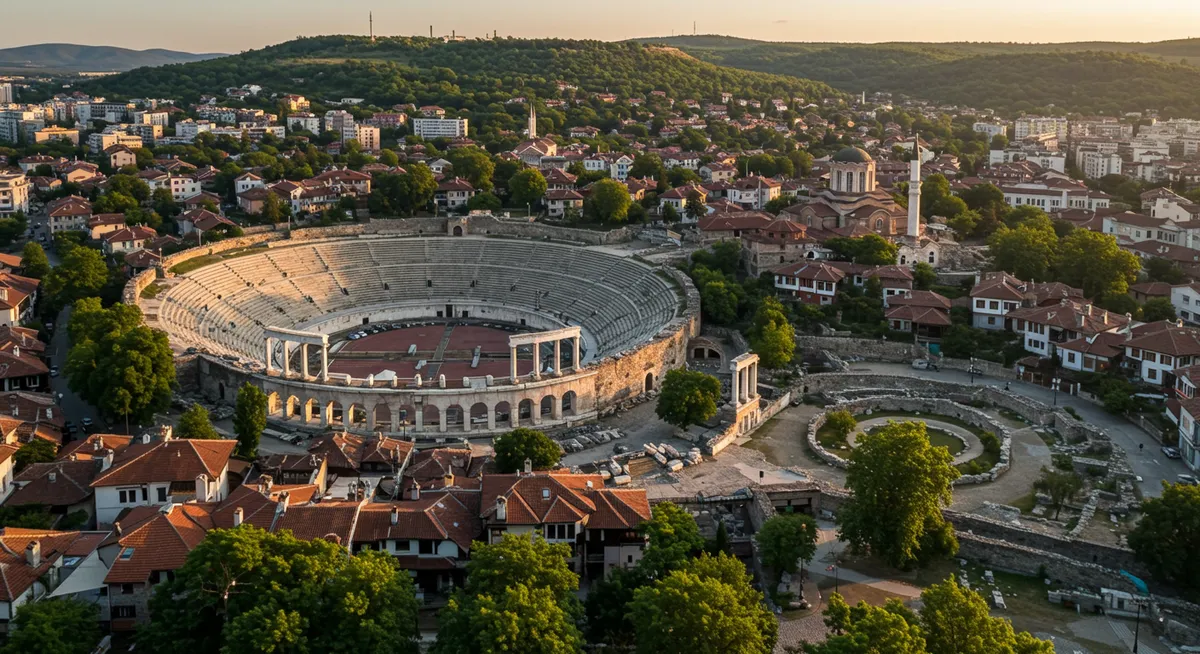
The Ancient Roman Theater of Philippopolis, built in the 1st century AD under Emperor Domitian and later expanded under Trajan and Hadrian, is one of the best-preserved Roman theaters in the world. Its 28 marble rows of seating, carved into the northern slope of Taksim Hill, frame a perfectly symmetrical stage that practically composes itself for the camera.
GPS coordinates: 42.1431° N, 24.7494° E. The main photography viewpoint is from the upper observation terrace accessible via the Old Town footpath along Tsenov Street.
Best time: Early morning (08:00–09:30) for soft, raking light that emphasizes the texture of the marble. At midday the stage is washed out with flat light. Golden hour is less optimal here because the theater faces north-east and the sun drops behind Taksim Hill early. During summer months (June–August) evening concerts are held; shooting during a performance captures the theater alive with audience and warm stage lighting.
Entrance fee (2026): BGN 6 (approx. €3) for the archaeological complex. Photography is permitted throughout; tripods allowed on the upper terrace. Check the official theater website for current concert schedules. For deeper historical context pair this stop with the ancient theatre Plovdiv guide and the Plovdiv Roman theater guide.
3. Old Town Colorful Houses — National Revival Architecture
The Old Town's National Revival houses — bold cobalt blues, sunset oranges, and canary yellows — are Plovdiv's most recognisable visual identity. Built mainly in the 18th and 19th centuries, these homes feature overhanging upper storeys (called "chardak"), ornate carved wooden ceilings visible through open gates, and walled courtyards bursting with roses and wisteria in spring.
Key streets for photography: Artin Gidikov Street and the lane alongside the Hindlian House offer the densest concentration of colourful facades within a 100-metre stretch. The hidden courtyard of the Georgiadi House (open to visitors) gives access to a classic Revival interior and a flowering garden that almost no tourists find.
Best time: Sunrise (06:00–07:30 in summer) for the most dramatic light and empty streets. The Old Town is heavily trafficked by 09:30 on weekdays and earlier on weekends. Overcast days eliminate harsh shadows and render the colours more saturated — arguably better than direct sun for facade shots.
Practical notes: The cobblestones are uneven; bring a low-profile tripod. Many of the revival houses are functioning museums (Hindlian House, Kuyumdzhioglu House) with small entrance fees of BGN 3–5. For a curated route around the best facades, follow the Plovdiv Old Town guide.
4. Kapana Creative District — Street Art and Urban Colour
Kapana ("The Trap"), Plovdiv's rejuvenated craft quarter, has become Bulgaria's most dynamic street-art canvas. The district's compact grid of narrow lanes is repainted each spring during the Kapana Fest and Plovdiv Design Week, meaning the murals you photograph in 2026 are genuinely different from those that appeared in travel blogs just two years ago.
Key photography zones within Kapana: The Bratya Pulevi Street corner (near the turquoise building at No. 4) hosts the district's most-photographed mural cluster. The side lane off Tsar Kaloyan Street has a kilometre of consecutive shop-front murals that create a strong leading-line composition when shot at low angle.
Best time: Overcast mornings or the first hour after sunrise for shadow-free mural shots. Midday direct sunlight bleaches colour. Evening is excellent for café-terrace ambience shots — the district's warm Edison-bulb lighting makes for cosy street photography after dark.
Practical notes: No entry fee. The district is at its most lively Thursday–Saturday evenings when local artisan shops and music venues are open. Pair your visit with the street art and creative spaces in Plovdiv guide and the Kapana Plovdiv creative quarter overview for tour options.
5. Bunardzhik Hill and the Alyosha Monument — Sunset Silhouettes
Bunardzhik Hill is Plovdiv's second-highest accessible hill and home to the Alyosha Monument — a 17-metre Soviet-era soldier statue that has become one of the city's most-photographed subjects in recent years thanks to its commanding silhouette against evening skies. The hill's open western exposure makes it the best place in Plovdiv to photograph sunsets without buildings interrupting the horizon.
GPS coordinates: 42.1511° N, 24.7398° E. The monument is accessible by road (parking available at the summit) or via a 20-minute walking trail from Hristo Botev Boulevard.
Best time: 30 minutes before sunset for classic silhouette shots of the monument against an orange sky. Shooting from east of the monument places the figure against the setting sun. The blue hour (15–25 minutes after sunset) produces a cool sky gradient that contrasts with the monument's concrete grey.
Practical notes: Free access, no entrance fee. The monument is illuminated at night, making after-dark photography possible. In summer the hill is popular with locals for evening walks — scout your exact position early. Cross-reference with best views in Plovdiv for a full comparison of all hilltop panoramas.
6. Danov Hill (Sahat Tepe) — 360° Cityscapes and the Clock Tower
Danov Hill — historically called Sahat Tepe (Clock Tower Hill) — is the most central of Plovdiv's hills and offers a true 360-degree view of the city. Its defining landmark is a 19th-century Ottoman clock tower, which makes an excellent foreground subject against the urban skyline backdrop. At just 158 m elevation, it is less dramatic than Nebet Tepe but significantly less crowded.
GPS coordinates: 42.1485° N, 24.7445° E. Entry from the Dzhumaya Mosque square, five minutes on foot.
Best time: Golden hour for warm-toned cityscape shots with the clock tower in the foreground. The eastern exposure gives excellent early-morning light on the tower face. Midday is workable because the open hilltop has no overhanging trees to create patchy shadow.
Practical notes: Free access. This is also a good secondary viewpoint for photographing the Roman Stadium ruins visible in Dzhumaya Square directly below — use a telephoto lens (70–200 mm) to isolate the ancient track lanes among the modern pedestrian plaza.
7. Maritsa River Banks — Water Reflections and Willow Landscapes
The Maritsa River, which bisects Plovdiv from east to west, is underused as a photography subject despite offering some of the city's best reflection shots and atmospheric riverside scenes. The willow-lined banks between the Rowing Canal bridge and the Hebros Hotel area produce classic weeping-willow-over-water compositions that are especially powerful at golden hour when the water turns gold.
Best sections: The northern bank between Kolodrum Bridge and Rowing Canal (approx. 1 km) is fully pedestrianised and flanked with cattails and willows. The southern bank near Maritsa Park has manicured flowerbeds that work well for foreground interest. In spring the banks host nesting ducks, adding wildlife elements to urban compositions.
Best time: Sunrise and golden hour for reflections — still air in the early morning creates mirror-like surfaces. Long exposures (2–8 seconds) with a neutral-density filter smooth the water into a silky layer. After rain the banks develop puddles that multiply any riverside lights.
Practical notes: Free and accessible 24 hours. The Rowing Canal (Гребен канал) section is the widest — ideal for wide-angle landscape shots incorporating both banks and sky. Parking is available along Otets Paisiy Street.
8. Tsar Simeon's Garden — Singing Fountains at Night
Tsar Simeon's Garden (Цар Симеонова Градина) is Plovdiv's oldest and largest public park, dating to 1892. By day it offers shaded alleys, ornamental fountains, and manicured flower parterre for classic park photography. By night it transforms: the Singing Fountains (Поющи фонтани), active in summer evenings (typically 21:00–22:30), produce choreographed water jets in a full colour-light spectrum that is both challenging and rewarding to photograph.
GPS coordinates: 42.1448° N, 24.7494° E. The garden is a 2-minute walk from the Central Post Office.
Best time for Singing Fountains: 21:00–21:30 in June–August when the show begins and crowds are still manageable. Use shutter speeds of 1/30–1/60 second to capture water movement while retaining colour saturation. A wide-angle lens from the northern bank of the fountain plaza captures the full arc of the jets.
Best time for daytime garden: Spring (April–May) when the rose beds peak. The morning light through the mature plane trees creates dappled patterns ideal for portrait and detail photography.
Practical notes: Free, open 24 hours. Singing Fountain schedule varies by year — confirm current showtimes on the Plovdiv municipality website before visiting. This garden connects directly to the Roman Stadium ruins and the main pedestrian zone.
9. The Ethnographic Museum — Interior Architecture and Cultural Details
The Regional Ethnographic Museum occupies the Kuyumdzhioglu House, a masterpiece of 19th-century Bulgarian National Revival architecture. Its interior is as photogenic as any exterior in Plovdiv: wooden coffered ceilings painted with floral motifs, wide bay windows flooding rooms with diffused northern light, and carefully arranged exhibits of embroidered costumes and copper craftwork.
GPS coordinates: 42.1432° N, 24.7488° E. Located on Dr. Chomakov Street in the heart of the Old Town.
Best time: Mid-morning (10:00–11:30) on a bright but overcast day for the most even interior light through the bay windows. Direct sun through the south-facing windows creates harsh contrast that is difficult to expose for. Flash photography is not permitted on most floors.
Entrance fee (2026): BGN 6 (approx. €3) for adults. Photography is permitted without additional charge; tripods require prior permission from staff. Ask at the ticket desk.
Practical notes: The museum courtyard — a flagstone space with stone wellhead and potted plants — is free to access and makes an excellent frame-within-a-frame composition through the gateway arch. Pair this visit with the hidden gems in Plovdiv guide for nearby unmarked Revival houses.
10. Kapana to Old Town — Market Stalls and Culinary Photography
The Saturday morning market at the edge of Kapana and the daily produce stalls along Dzhumaya Square offer some of the best candid and food-photography opportunities in Plovdiv. Bulgarian cheeses (kashkaval, sirene), bunches of dried herbs, and stacks of red peppers provide rich colour and texture for still-life shots, while the interaction between vendors and customers creates authentic street-portrait moments.
Best time: 07:30–09:30 on Saturday for the widest selection of produce and the softest morning light. Vendors are generally happy to be photographed — ask first with a smile, especially older stallholders.
Practical notes: Free to enter. A 50 mm or 85 mm prime lens is ideal for market photography — wide enough for context, long enough to compress backgrounds and isolate subjects. Read more about the food scene in the Plovdiv 1-day itinerary.
Aerial and Drone Photography in Plovdiv — 2026 Rules
Drone photography is increasingly popular in Plovdiv, and the city's hilltop skylines and Maritsa River landscape are spectacular from the air. However, regulations require careful compliance in 2026.
Bulgaria follows EU Regulation 2019/947 supervised by the Directorate General Civil Aviation Administration (DGCAA). Key rules for recreational and semi-professional operators:
- Open Category (A1/A3): drones under 250 g (e.g. DJI Mini 4 Pro) can be flown without registration but must stay below 120 m AGL and within visual line of sight (VLOS).
- Drones 250 g – 25 kg: operator registration with DGCAA required before the first flight. Registration is done online via the DGCAA e-services portal.
- Plovdiv Old Town / Roman Theater area: this zone is within the Plovdiv CTR (control zone), which technically requires coordination with Plovdiv Airport (LBPD) for any flight, even at low altitude. In practice, sub-250 g drones in the A1 subcategory face fewer restrictions, but always check for active NOTAMs via caa.bg before flying.
- Historical monuments: flying directly over the Roman Theater or Old Town buildings may require a separate heritage-site permit from the National Institute for Immovable Cultural Heritage. Contact the Plovdiv Regional Museum of History for guidance.
- No-fly zones: Plovdiv Airport (LBPD) requires an 8 km clearance. Military installations south of the city are hard restricted. Always verify using the EU Drone Rules map before flight.
Best aerial subjects in Plovdiv: the Rowing Canal at sunrise (minimal traffic, mirror water surface), Bunardzhik Hill at sunset framing the Alyosha Monument against the western horizon, and the Bachkovo Monastery valley (outside Plovdiv's CTR, no coordination needed) for mountain-landscape aerials.
Hidden Viewpoints Locals Love in Plovdiv
Beyond the famous hills, Plovdiv has several lesser-known vantage points that local photographers use to avoid the crowds and find fresh compositions.
Dzhendem Tepe (Hill of the Devil): The smallest and least-visited of the city's hills (GPS: 42.1499° N, 24.7527° E), it provides a northeast-looking panorama across the modern city toward the Stara Planina foothills — a view almost never seen in travel photography. The hill is accessed via a rough footpath from Vasil Aprilov Boulevard; no facilities but completely free and typically empty even on weekends.
The rooftop of the Novotel Plovdiv: The hotel's rooftop terrace (accessible to non-guests who purchase a drink at the rooftop bar in summer) gives an urban midrise vantage point across the Maritsa River toward the Old Town hills — ideal for compression shots with a 70–200 mm lens.
The Rowing Canal footbridge: A utilitarian pedestrian bridge over the widest section of the Rowing Canal gives a symmetrical water-corridor composition that works especially well at dusk with the Canal's border lighting reflected in the water.
Georgiadi House garden gate: On Konstantin Stoilov Street in the Old Town, an arched gateway frames a perfectly composed Revival-house garden scene. Locals know it; tourist crowds almost never stop here. Best light: mid-morning when the sun enters the courtyard at a low angle.
Practical Photography Tips for Plovdiv
A few field notes from repeated visits that will save you time and improve your results:
- Golden hour is transformative here. The warm terracotta palette of the Old Town rooftops amplifies amber light in a way that mid-latitude European cities rarely do. Plan at least one hilltop shoot at sunset.
- Blue hour follows immediately and is often better. Stay on Nebet Tepe or Bunardzhik for 20–25 minutes after the sun sets. The soft indigo sky balances perfectly with the city's warm electric light.
- Bring a wide-angle and a telephoto. Wide (16–24 mm full-frame equivalent) for hilltop panoramas and tight Old Town lanes. Telephoto (70–200 mm) for compressing the Roman Stadium from Danov Hill and for market portraits.
- Cobblestones eat tripod feet. Use a bag clip or sandbag to stabilise your tripod in the Old Town. The stones are irregular enough that standard spike feet shift during long exposures.
- The Plovdiv Card (BGN 15 / 3 days, 2026): covers entrance to 9 museums and monuments including the Ethnographic Museum and Archaeological Museum. Worthwhile if you are doing multiple interior shoots.
Frequently Asked Questions About Photography in Plovdiv
What is the single best photography spot in Plovdiv?
The single best photography spot in Plovdiv is Nebet Tepe Hill (42.1468° N, 24.7474° E) visited 40 minutes before sunset. The 270-degree panorama across the Old Town's terracotta rooftops, framed by ancient Thracian walls, consistently produces the most impactful cityscape images. Stay through the blue hour for long-exposure cityscapes with city lights. No entrance fee; allow 10 minutes on foot from the Old Town entrance.
When is golden hour in Plovdiv and which spots benefit most?
In Plovdiv, golden hour in May 2026 occurs approximately 06:00–07:00 at sunrise and 19:45–20:30 at sunset. The spots that benefit most are the hilltop viewpoints (Nebet Tepe, Bunardzhik, Danov Hill) where the warm light rakes across the entire city panorama, and the Maritsa River banks where the water surface reflects orange sky tones. The Old Town houses also photograph best in golden light, which saturates their already vivid colours.
Is drone photography allowed in Plovdiv's Old Town?
Drone photography over Plovdiv's Old Town requires caution. The area falls within the Plovdiv Airport (LBPD) control zone, requiring coordination for most drone classes. Sub-250 g drones in the EU Open Category A1 face fewer restrictions but operators must still check for active NOTAMs via the DGCAA website (caa.bg) before each flight. Flying directly over the Roman Theater or other protected monuments may additionally require a heritage-site permit. Always verify on the EU Drone Rules map before flying.
What camera gear should I bring for photographing Plovdiv?
For Plovdiv photography in 2026, bring a wide-angle lens (16–24 mm full-frame equivalent) for hilltop panoramas and confined Old Town lanes, a standard zoom or 50 mm prime for street and market photography, and a telephoto (70–200 mm) for compressing the Roman Stadium from Danov Hill and isolating architectural details. A tripod is essential for golden-hour and blue-hour work on the hills and at the Singing Fountains. A neutral-density filter helps with long-exposure Maritsa River reflections.
Are there any photography restrictions inside Plovdiv's museums?
Most of Plovdiv's museums permit photography without flash at no extra charge, including the Ethnographic Museum and the Hindlian House. Tripods generally require prior permission from staff — ask at the ticket desk. The Roman Theater complex (BGN 6 entrance, approx. €3 in 2026) allows tripods on the upper observation terrace. Some temporary exhibition rooms in the Regional Historical Museum restrict photography entirely — look for signs at room entrances.
What hidden photography spots do locals recommend in Plovdiv?
Local photographers in Plovdiv favour Dzhendem Tepe (Hill of the Devil, GPS 42.1499° N, 24.7527° E) for an uncrowded northeast panorama; the Georgiadi House garden gate on Konstantin Stoilov Street for a framed Revival-house courtyard shot; and the Rowing Canal pedestrian footbridge at dusk for symmetrical water-reflection compositions. These spots are rarely featured in tourist photography and are entirely free to access.
Plovdiv rewards the photographer who is willing to rise early, stay late, and wander beyond the main tourist circuits. From the ancient stones of the Roman Theater catching the first morning light to the Kapana murals saturated in afternoon colour, every hour here produces a different city. Use the Plovdiv walking tour guide to string these spots into a logical daily route, dive deeper into the hilltop panoramas with the best views in Plovdiv guide, and explore the wider cluster with the full things to do in Plovdiv pillar. For the most comprehensive day plan integrating photography with sightseeing, see the Plovdiv 1-day itinerary.