
Things To Do in Ruse Winter
Discover the best things to do in Ruse in winter 2025. Explore top attractions, cultural events, and cozy winter activities in this comprehensive guide.
On this page
Top Things To Do in Ruse in Winter
Ruse in winter is quieter than the summer riverboat months, and that is exactly its appeal. Between December 2025 and February 2026 the Danube fog rolls in early, snow dusts the Vienna-style facades around Liberty Square, and the city pivots indoors to museums, the opera, mehana dinners, and a compact Christmas market that locals actually use. This guide covers what is open, what is worth a ticket in low season, and how to spend three short winter days in Bulgaria's most architecturally surprising river city.
Ruse winter weather and what to pack
Winter in Ruse runs cold and damp rather than alpine. December averages -1 C to 5 C, January drops to -4 C to 3 C, and February usually sits between -2 C and 6 C. Snow is common but rarely deep, and the bigger problem is the Danube fog that can sit over the city for days, killing visibility along the riverfront and slowing traffic on the Friendship Bridge to Giurgiu. Wind off the river makes it feel several degrees colder than the thermometer suggests.
Pack waterproof boots with grip, a windproof outer layer, gloves, and a hat. Pavements around Liberty Square and Aleksandrovska Street are cobbled or polished stone and turn slick when wet. Hotels and museums are reliably overheated, so layer with a thin merino base rather than thick knitwear you cannot peel off. A small daypack helps because cloakrooms at Ruse museums are inconsistent.
Christmas market on Liberty Square (December 2025)
The Ruse municipal Christmas market sets up on Ploshtad Svoboda (Liberty Square) and the pedestrian stretch of Aleksandrovska Street from late November through early January. Expect roughly 25 to 35 wooden chalets selling mulled wine (greyano vino) for 4 to 6 BGN, grilled sausages, banitsa, honey from Rusenski Lom beekeepers, hand-knit wool socks, and ceramics from Troyan. The Christmas tree in front of the Profitable Building (Dohodno Zdanie) is lit in a public ceremony around the first weekend of December, and an ice rink usually operates near the Monument of Liberty for around 5 BGN per hour including skate rental.
The market is small compared with Sofia or Plovdiv, but that is a feature: it is genuinely local, prices are honest, and you can walk the whole thing in 20 minutes. Go after 17:00 when the lights come on and the choirs from local schools tend to perform. Avoid weekday lunchtimes when most stalls only half-open. For more central Things to do in Ruse within a five-minute walk, the square sits next to the History Museum, the opera, and the main cafe strip.
New Year's Eve and Surva traditions
New Year's Eve (Nova Godina) in Ruse is celebrated outdoors on Liberty Square with a municipal countdown, fireworks fired from the riverside near Pristanishte (the port), and a brass band. The crowd is family-heavy and the atmosphere is closer to a small-town gathering than a clubbing night. Restaurants run set menus from around 80 to 180 BGN per person and need to be booked by mid-December; walk-ins on the night are nearly impossible. Most museums close on 1 January and reopen 2 January.
On 1 January, watch for survakari, children carrying decorated dogwood branches called survachki who tap adults on the back for coins and good luck. This is a living Bulgarian tradition you will see in residential neighbourhoods like Druzhba and Charodeika more than on the central square. If you are in Ruse around 13 to 14 January, the Surva mummer parades take place in nearby villages in the Rusenski Lom valley, with masked kukeri performers chasing winter spirits away. Hotel concierges can usually point you to which village hosts that year's parade.
Indoor museum hopping when it snows
Ruse has the densest cluster of small, walkable museums in northern Bulgaria, and a snowy day is when you finally use them. A practical loop in winter: start at the Regional History Museum on Liberty Square (entry around 6 BGN, two hours) for the Borovo Thracian silver treasure, then walk five minutes to the Sexaginta Prista Roman fortress remains on the riverfront for context on Ruse's military past. Continue to the Pantheon of National Revival Heroes in Park na Vazrozhdenisite (entry 4 BGN), where 453 figures of the Bulgarian liberation movement are commemorated under a gilded dome.
In the afternoon, visit the Zahari Stoyanov House Museum and the Baba Tonka House Museum, both five-minute walks apart in the old centre and both included in a combined 8 BGN ticket with the History Museum. Finish at the Museum of Urban Lifestyle in the Kaliopa House, a restored 19th-century merchant home where a single woodstove still heats the parlour exactly as it did when the Belgian consul lived there. Most Ruse museums close on Mondays in winter and shut by 17:00, so plan the loop for Tuesday through Friday and start by 10:00.
Ruse Opera and winter cultural calendar
The State Opera Ruse runs its main season from October through May, which makes winter the strongest time to catch a performance. Tickets cost 15 to 35 BGN, dramatically cheaper than Sofia or Vienna for comparable productions, and the neo-baroque hall on Ploshtad Sveta Troitsa seats only 600 so there is no bad seat. The December and January programme typically includes The Nutcracker, La Boheme, Bulgarian folk-opera evenings, and a New Year's gala concert. Buy tickets at the box office on Pridunavski Boulevard or through the opera's website at least a week ahead for weekend shows.
Beyond the opera, the Dohodno Zdanie hosts the Sava Ognyanov Drama Theatre and chamber concerts most weekends. The State Philharmonic Ruse plays Friday evenings at the opera hall. The Ruse Art Gallery on General Skobelev Street rotates winter exhibitions of Bulgarian painting and is free on the last Thursday of each month.
Stroll the Danube riverfront and Friendship Bridge views
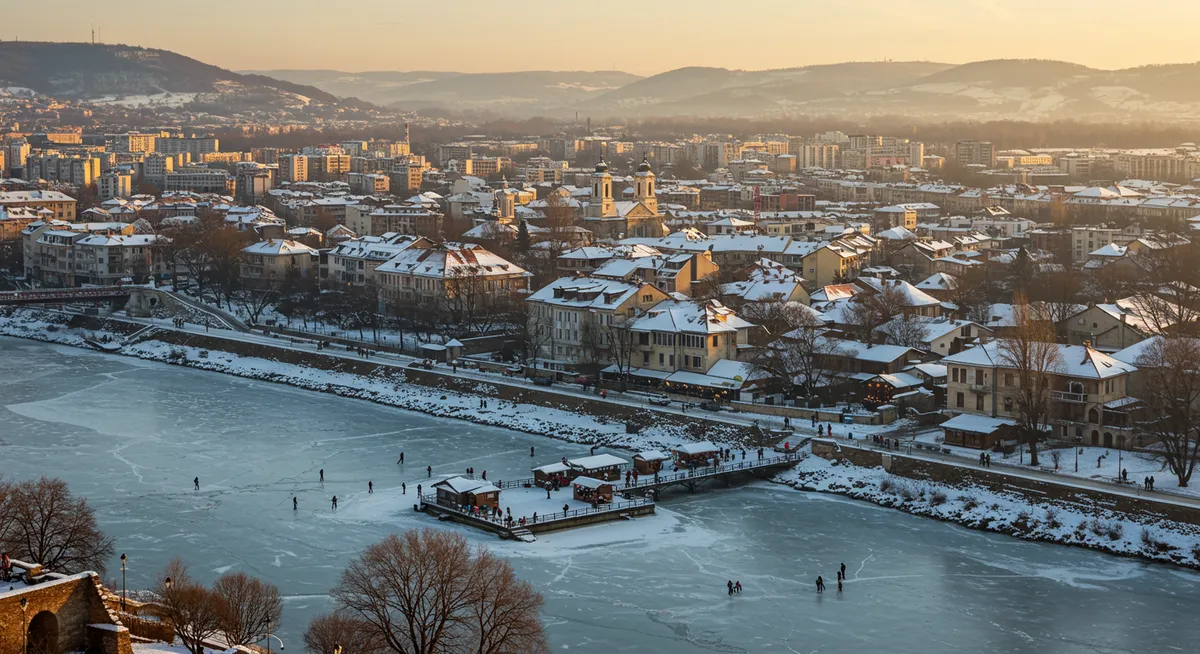
The Danube riverfront promenade runs roughly two kilometres from the port at Pristanishte east to the Sexaginta Prista park. In winter the river often carries thin ice floes and the far bank in Romania disappears into fog, which gives the walk a Mitteleuropean melancholy that summer never delivers. The Friendship Bridge (Most na Druzhbata), built in 1954 to link Ruse to Giurgiu, is best photographed from the eastern end of the promenade around mid-afternoon when low winter sun lights the steel trusses.
Dress for wind: there is nothing to break it between the river and the city. Warm-up stops include Cafe Rai near the port, Chiflika mehana up the hill, and the cafe inside the Pantheon park. If the Danube freezes hard, which happens once or twice a decade, locals walk out on the floes near the port; this is unsafe and discouraged, but it is part of the winter folklore here.
Day trip to Ivanovo Rock Churches and Rusenski Lom
The Ivanovo Rock-Hewn Churches, a UNESCO site 20 km south of Ruse, stay open year-round but with reduced winter hours (typically 10:00 to 16:00, closed Mondays and Tuesdays). Winter visits are spectacular when frost coats the limestone cliffs and the 13th- and 14th-century frescoes inside the Church of the Holy Virgin look almost untouched in the cold light. Entry is 6 BGN. Drive yourself, take a taxi (around 30 BGN one way), or arrange a half-day tour from Ruse for 60 to 80 BGN.
Combine Ivanovo with the cliff-top ruins of Cherven Fortress (10 km further) for a full day in the Rusenski Lom National Park. Wear boots with real grip; the path up to Ivanovo is steep stone steps that ice over by late afternoon. Pack a thermos because there is no cafe at the site in winter, and check weather the morning of your trip because the access road is not always cleared after heavy snow.
Day trip to Veliko Tarnovo
Veliko Tarnovo is a 1 hour 45 minute drive south on Route E85 and runs as a comfortable winter day trip from Ruse. The medieval Tsarevets Fortress is open daily 09:00 to 17:00 in winter (entry 10 BGN), and the famous Sound and Light show only runs on request for groups outside the high season, so do not plan around it in December or January. The cobblestone Samovodska Charshia craft street stays atmospheric in snow, and the walk up to the Asenevtsi Monument from the river gorge is one of the best winter views in Bulgaria.
If you have an extra hour, detour to Arbanasi village 4 km north for the painted interior of the Nativity Church (entry 6 BGN) and a lunch of gyuvech and rakia at Mehana Izvora. Buses from Ruse central station to Veliko Tarnovo run hourly and cost around 14 BGN one way; the train is slower and not recommended in winter due to fog delays.
Mehana dinners and Bulgarian winter food
Winter is when Ruse's mehanas earn their keep. Order kapama (slow-cooked meat and cabbage layered in a clay pot), gyuvech (a vegetable and meat stew baked in earthenware), shkembe chorba (tripe soup, the local hangover cure), and bob chorba (bean soup with savory and mint). Pair with a carafe of red Mavrud or Gamza from the Danube plain, or a 50 ml shot of grape rakia served warm with honey on cold nights. Expect to spend 25 to 40 BGN per person for a full meal with drinks.
Reliable mehanas in central Ruse include Chiflika on Otets Paisii Street, Mehana Strannopriemnitsa near the port, and Leventa restaurant inside the 19th-century Levent Tabia fortress on the bluff above the city, which has the best Danube view in town and a wood-fired interior built for winter. Reserve Friday and Saturday evenings; locals fill these places year-round.
Cozy cafes, hot chocolate and winter coffee
Bulgarian cafe culture is at its strongest in winter, and Ruse's compact centre means you are never more than three blocks from a good one. Cafe Rai on Aleksandrovska Street does the city's best hot chocolate, served thick like Italian cioccolata densa for around 5 BGN. Cafe Bohem near the opera is the writers-and-actors hangout with marble tables and Viennese melange. Chocolate House on Ploshtad Sveta Troitsa serves house-made truffles and a winter speciality called salep, a hot drink made from orchid root that you will not find in summer.
For working remote, Cafe Sundream on Borisova Street has reliable wifi, plug sockets, and a quiet upstairs room. Bulgarian filter coffee is rare; standard orders are espresso, macchiato, or cappuccino, and a long American-style coffee is called amerikano. Expect to pay 2.50 to 4 BGN for coffee and 6 to 10 BGN for cake.
Where to stay in Ruse in winter
Winter is low season, which means four-star hotels in the centre drop to two-star summer prices. Splendid Hotel and Cosmopolitan Hotel both sit on or near Liberty Square and run around 80 to 130 BGN per night for a double in December and January, breakfast included. Riga Hotel on the riverfront has the Danube views but is a 15-minute walk from the centre, which matters in cold weather. For boutique character, look at Anna Palace, a restored 1890s mansion two blocks from the opera.
Avoid apartment rentals in pre-1990 panel blocks unless the listing specifies central heating is included; some Ruse buildings still rely on individual electric heaters that struggle in January. Confirm with the host that hot water and heating are 24-hour before booking. For more orientation across the city's neighbourhoods, see our broader guide to Best Things to Do in Ruse.
Getting to Ruse in winter
Ruse is 320 km from Sofia (4 hours by car on the A2 motorway, longer in snow), 200 km from Varna, and only 65 km from Bucharest across the Friendship Bridge. The Bucharest connection is the underused winter trick: fly into Bucharest Otopeni, take a 90-minute direct bus or shared transfer for around 25 EUR, and you skip Bulgaria's winter road network entirely. Wizz Air and Ryanair both fly Bucharest cheaply from across Europe.
From within Bulgaria, the Sofia-Ruse train takes 6 to 7 hours and is reliable but slow; the bus from Sofia Central Bus Station is faster at around 5 hours and costs 30 to 40 BGN. Driving yourself, watch for black ice on the Veliko Tarnovo-Ruse stretch of the E85 in January, and carry winter tyres which are legally required from 15 November to 1 March.
Frequently Asked Questions
Is Ruse worth visiting in winter?
Yes, particularly between mid-December and mid-January when the Christmas market is open and the opera season is in full swing. Winter is also the cheapest time to stay in Ruse's central hotels and the easiest time to get a table at top mehanas like Leventa or Chiflika.
Does Ruse have a Christmas market?
Yes. The municipal Christmas market runs on Liberty Square (Ploshtad Svoboda) from late November to early January with around 25 to 35 chalets, mulled wine, an ice rink, and choir performances most evenings. It is small but genuinely local.
How cold does Ruse get in January?
January averages -4 C to 3 C with frequent fog off the Danube and occasional snow. Cold spells can drop to -10 C for a few days. Wind off the river makes it feel colder, so pack windproof layers and waterproof boots with grip.
Are Ruse museums open in winter?
Most are open Tuesday through Sunday with reduced hours (typically 10:00 to 17:00) and close on Mondays. The Regional History Museum, Pantheon of National Revival Heroes, Kaliopa House, and Zahari Stoyanov House all stay open through the season. Buy a combined ticket for the best value.
Can I do Ivanovo Rock Churches as a winter day trip from Ruse?
Yes, but check opening hours (10:00 to 16:00, closed Mondays and Tuesdays in winter) and weather before going. The path is steep stone steps that ice over, so wear boots with grip, and there is no cafe at the site so bring a thermos.